PROJECT: HYPERBUILDING STRUCTURE
YEAR: 2025
LOCATION: Tokyo, Japan
NATURE: Academic
UNIVERSITY: IAAC
COURSE: BIM Design Studio | UNS
TEAM: Joaquín Broquedis
GRADE: 9.5/10
For this design studio—led by Cristobal Burgos and Pablo Atuna Molina (UNS)—we developed a hyperbuilding for Tokyo exceeding 1,000,000 m². The studio operated as an 18-person collaboration, organized into specialized teams (Services, Structure, Façade, Industrial, Residential, and Data). Together with Joaquin Broquedis, we formed the Structure team.
The brief pushed us to think beyond conventional high-rise logic and propose novel, scalable systems. Throughout the process, we worked in close coordination with the other teams—especially Façade, Residential, and Services—to align structural decisions with programmatic, and technical strategies.
Across the entire project, our unified concept was inspired by "Ensō" (the circle): a “complete circle of life” where the hyperbuilding is understood as a set of continuous cycles—resources, climate response, communities, and movement. In that spirit, the Structural vision frames the structure as the vessel that supports and contains the building’s flows: the flow of forces and the flow of people, while facilitating spatial flexibility.
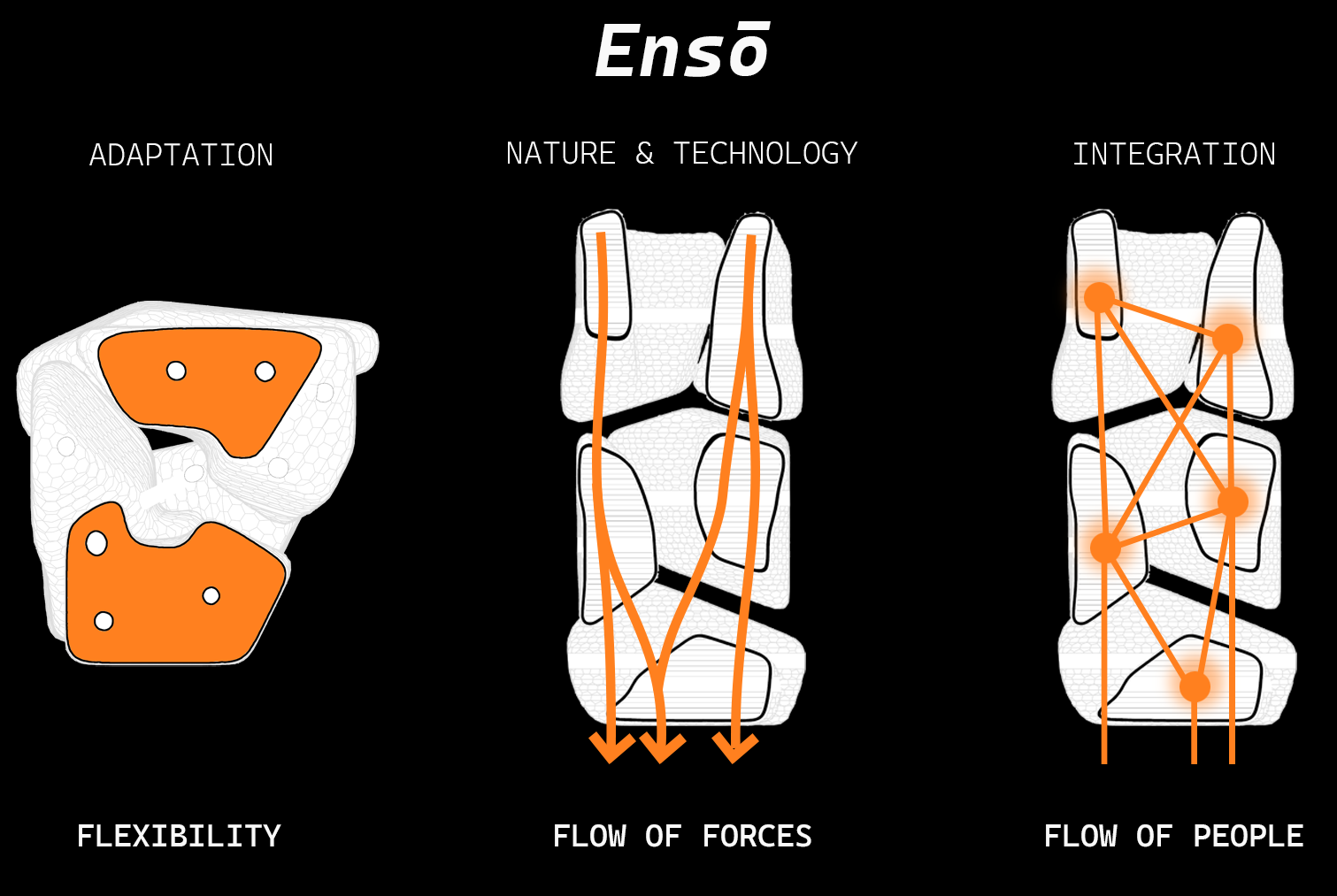
From the very beginning, our structural strategy was guided by three interrelated principles that have been derived from the overarching Hyperbuilding vision of ENSO:
1) Flexibility – Reducing obstructions caused by structural elements to free up spatial possibilities.
2) Natural Flow of Forces – Allowing structural loads to move fluidly through the system without unnecessary detours or inefficiencies.
3) Natural Flow of People – Ensuring that the structural design enhances rather than limits human movement and interaction.
2) Natural Flow of Forces – Allowing structural loads to move fluidly through the system without unnecessary detours or inefficiencies.
3) Natural Flow of People – Ensuring that the structural design enhances rather than limits human movement and interaction.
Instead of treating these objectives separately, we developed an overarching structural concept that merges all three into a coherent system.
CONCEPT
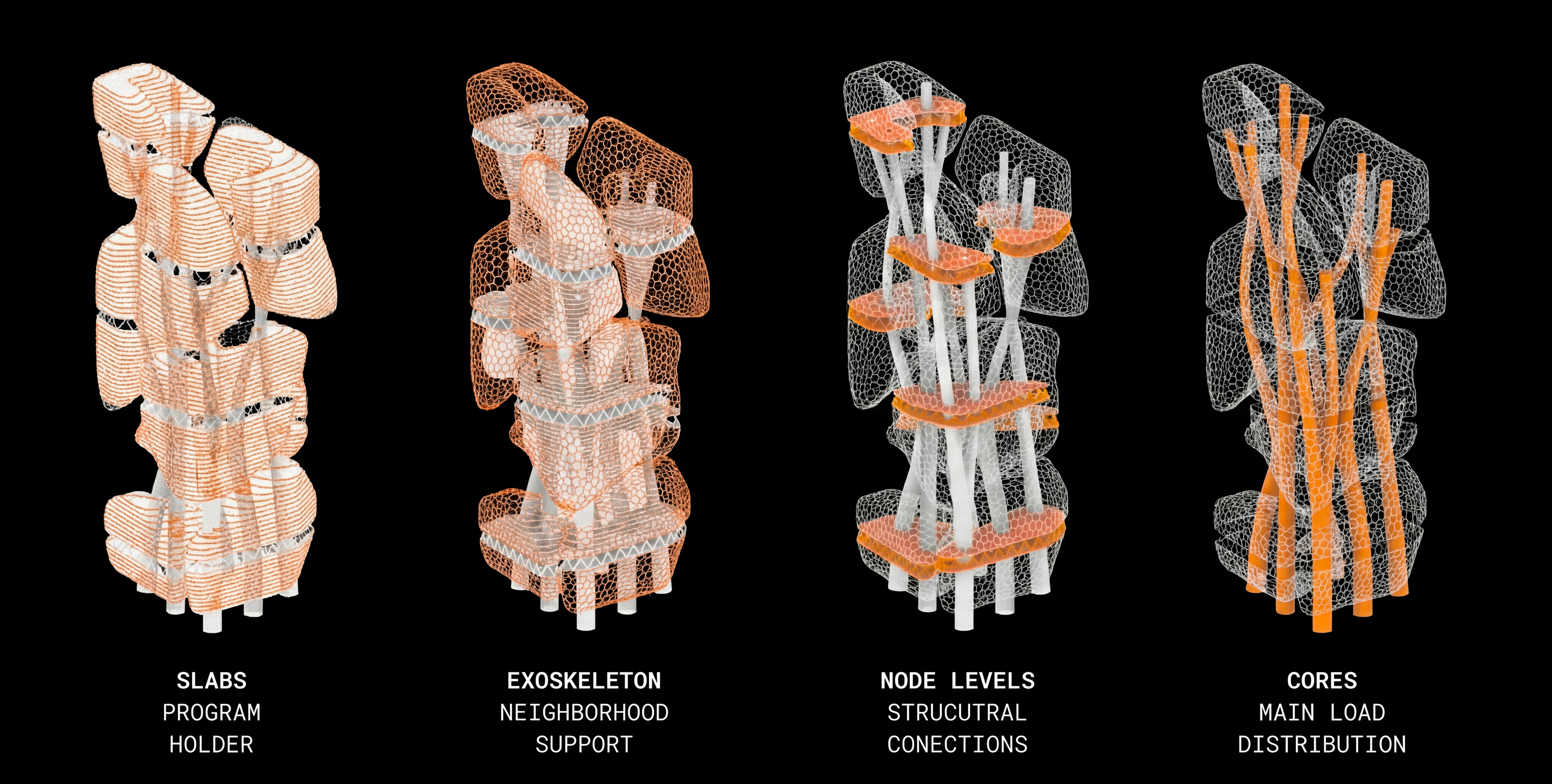
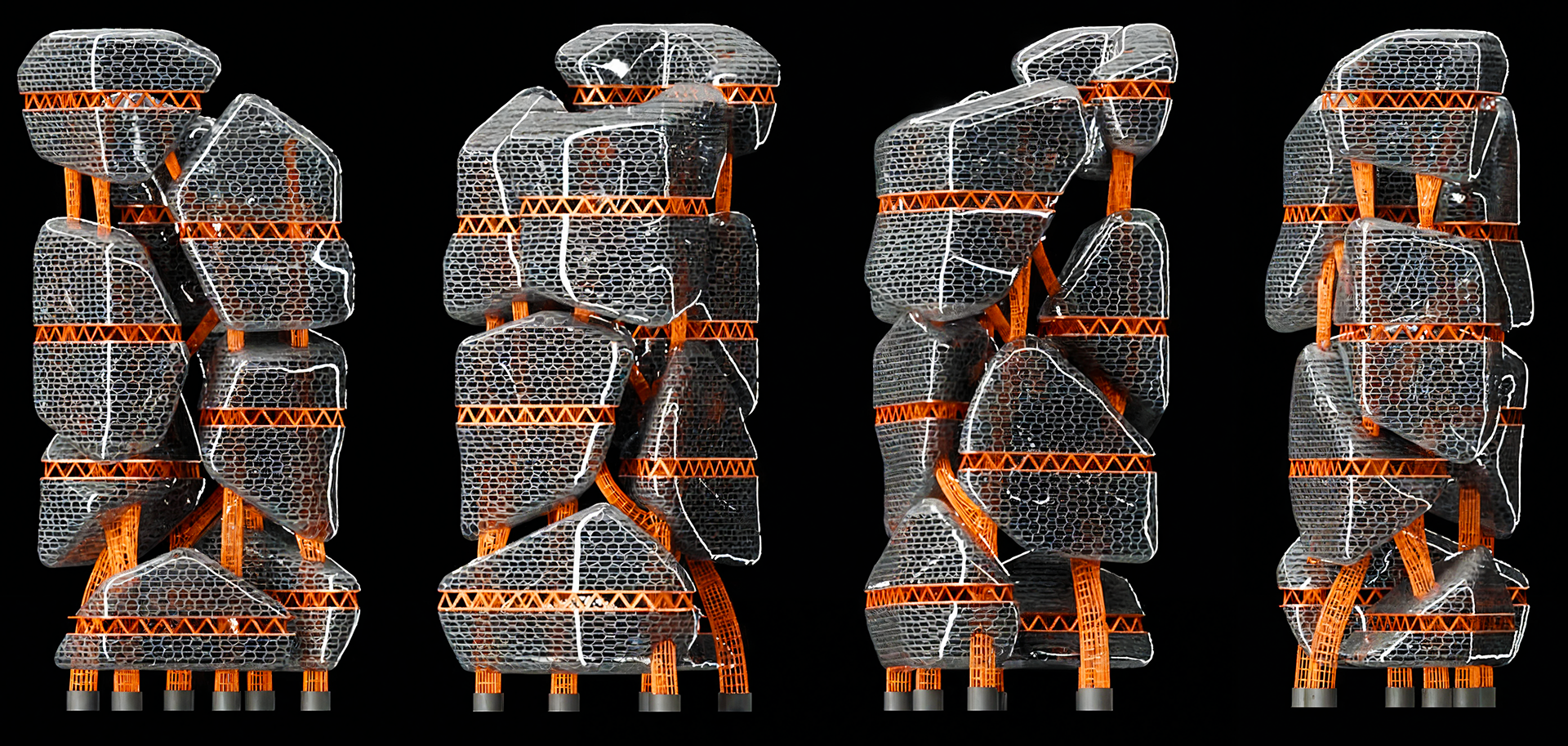
The structural design of Hyper A consists of eight floating neighborhoods of which the slabs are supported by spaceframes. These spaceframes are connected to a bold exoskeleton, which serves a triple function:
1) It resists torsional forces,
2) It supports the building façade,
3) And it transfers the slab loads to the node levels.
2) It supports the building façade,
3) And it transfers the slab loads to the node levels.
The node levels are massive, multi-story rigid boxes that play a central role in the structure. They’re not just physical anchors; they also function as transportation hubs and social spaces—integrating infrastructure, community, and structure in one move.
From there, the loads are transferred to a set of topologically optimized cores that also hold the transportation systems. These are not only vertical but also diagonal, enhancing both structural performance and physical connectivity between neighborhoods. By doing so, we encourage social interaction and connectivity.
STRUCTURE: BUILDING LEVEL
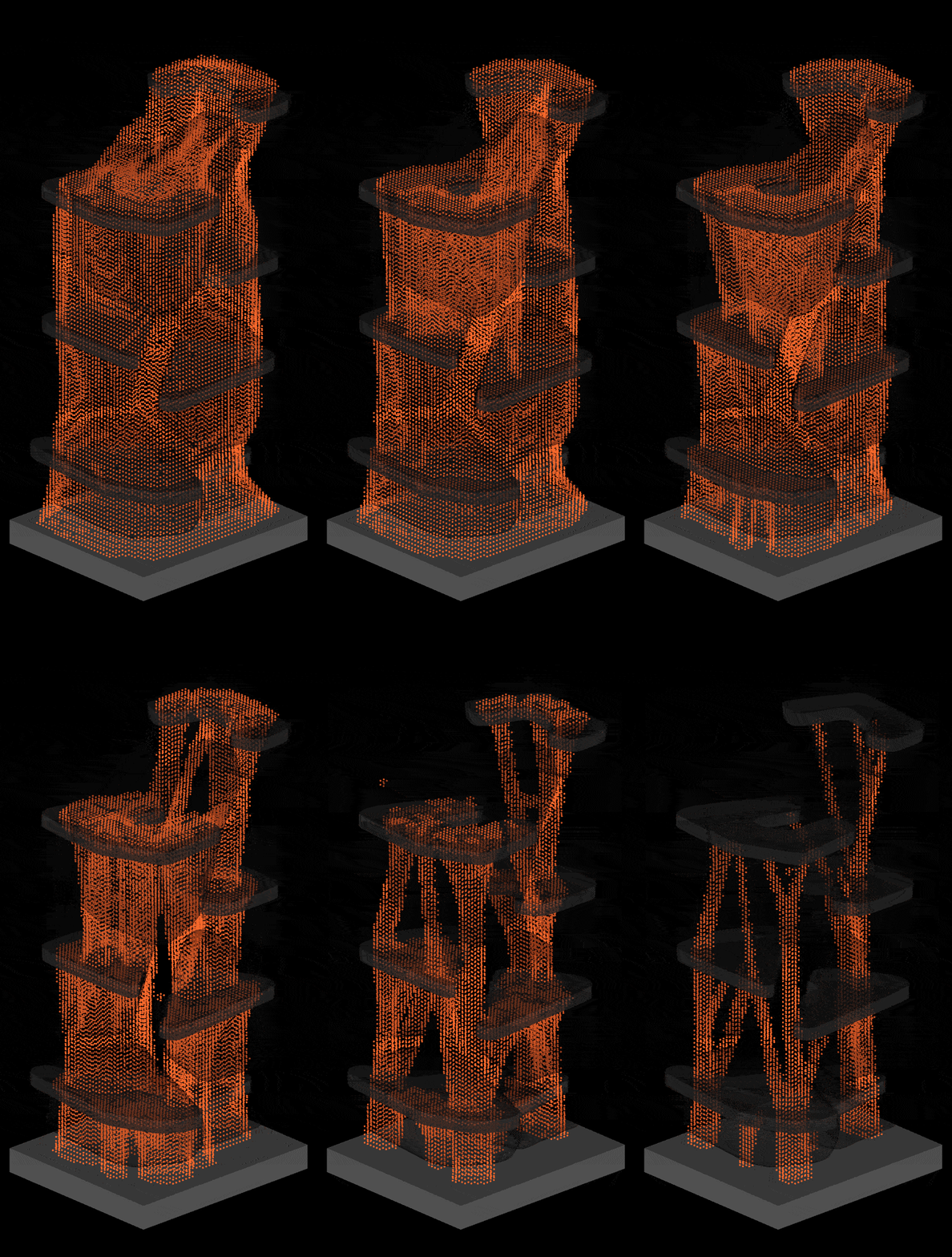
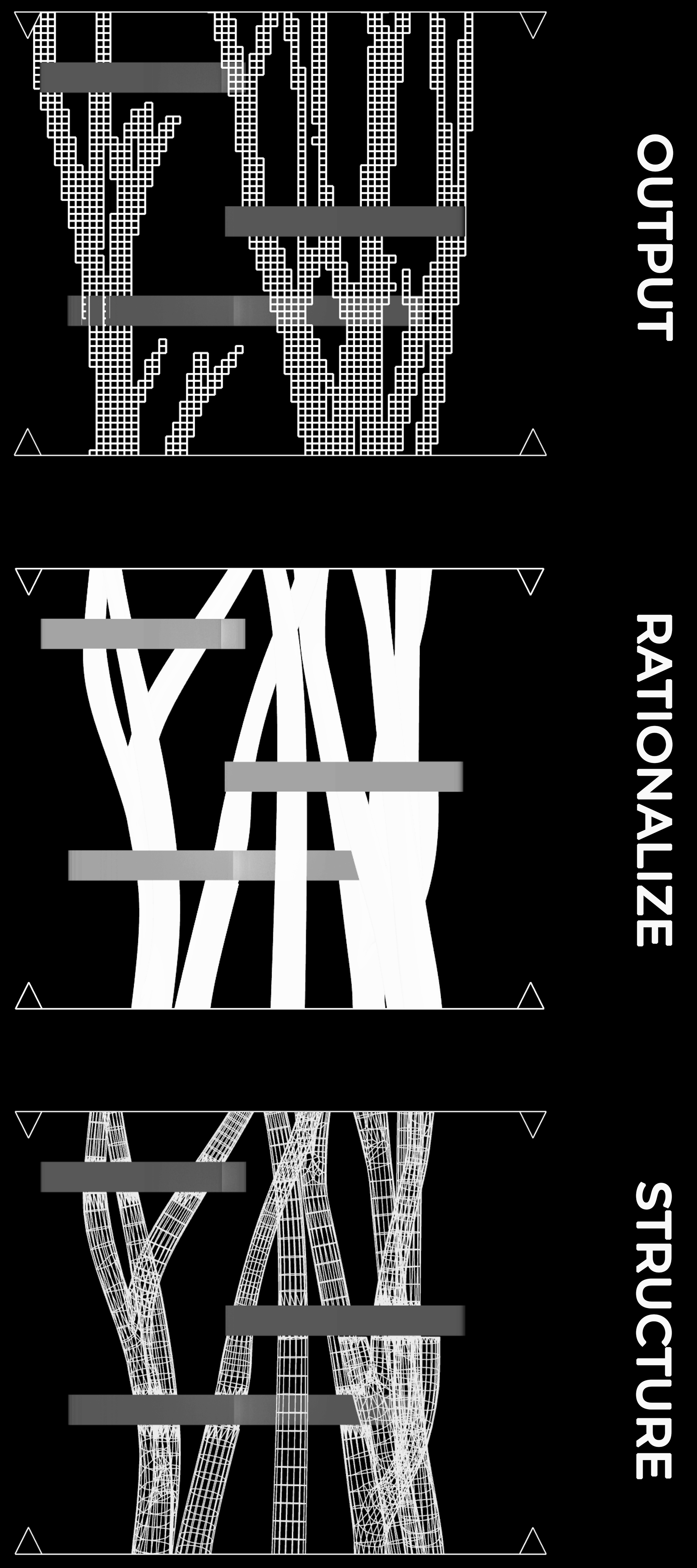
Now we will move on to the first of our two keypoints: the structure on the building level. The main structural system consists of topologically optimized cores.
Topological optimization is a computational design method that mimics the way nature, such as bone structures, distributes material only where it’s needed for strength and efficiency—making it the ideal tool for designing our coresystem, which had to be both structurally efficient and minimal to allow for flexibility a natural flow of forces and people.
In the middle you can see an animation of the topological optimization process of the core system. As you can see, material is reduced to 0.08 and only remains where needed for structural purposes.
As the output of this process consisted of voxels, we went through a process of rationalization, where we calculated the cross-sections of the geometry, created centerlines and used a multipipe with variable radius to create clean geometry. From this we could easily extract the structural elements.
As the output of this process consisted of voxels, we went through a process of rationalization, where we calculated the cross-sections of the geometry, created centerlines and used a multipipe with variable radius to create clean geometry. From this we could easily extract the structural elements.
STRUCTURE: NEIGHBORHOOD LEVEL
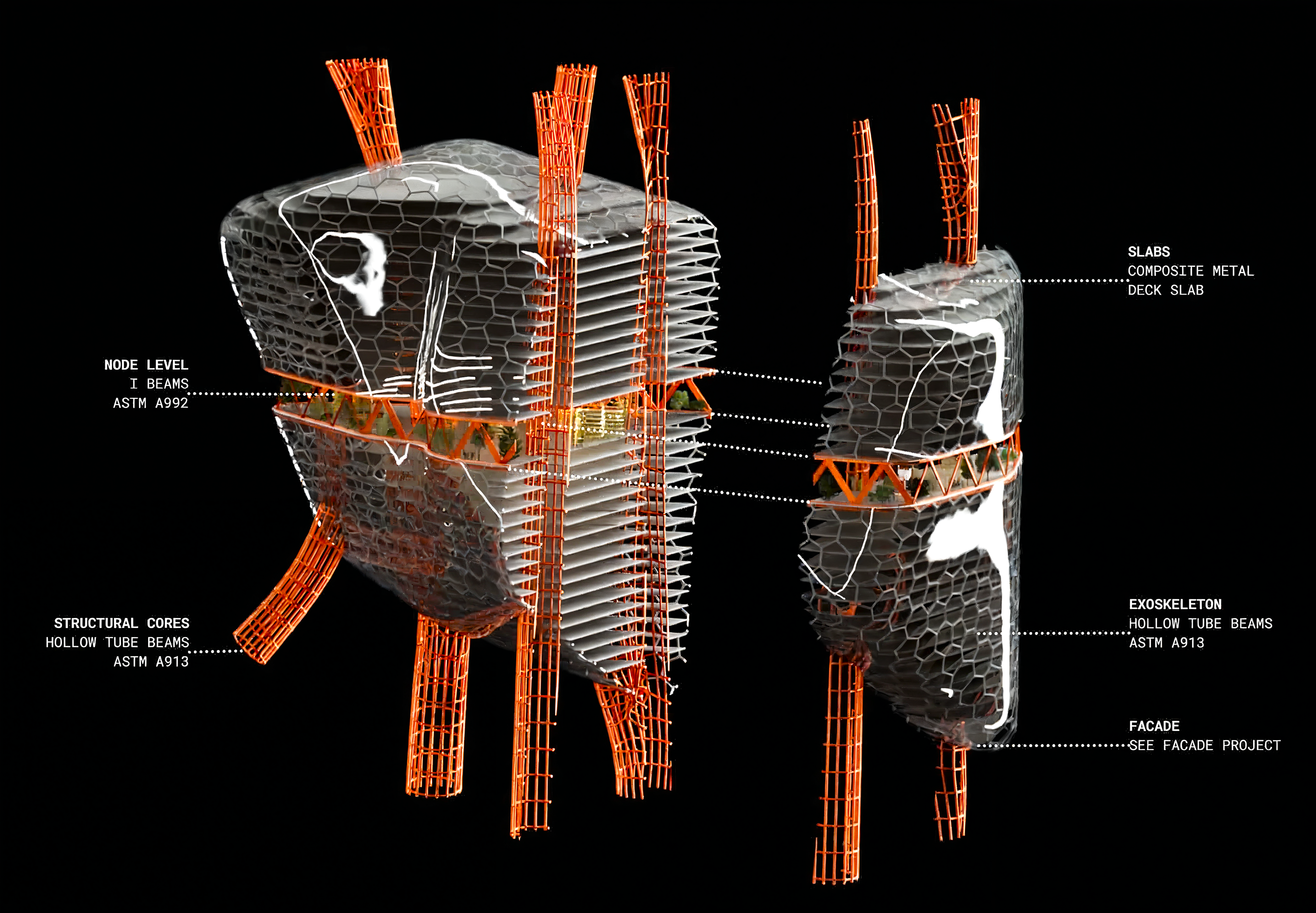
Zooming in to the neighborhood scale, the structural logic unfolds in more detail:
1) Tubular hollow steel beams form the core circulation structures, intersecting each neighborhood like a spine.
2) The node levels are constructed from large steel I-beams configured into a robust spaceframe. These are the most critical structural elements—linking exoskeletons to cores, and offering support for programs, industries, and social hubs.
3) Composite metal deck slabs make up the floor plates—lightweight yet strong.
4) The exoskeleton, also built from tubular hollow steel, supports the façade and carries loads back to the nodes.
This integration ensures that each neighborhood isn’t just structurally sound but also lively, flexible, and socially activated.
COLLABORATION & AUTOMATION OF WORKFLOWS
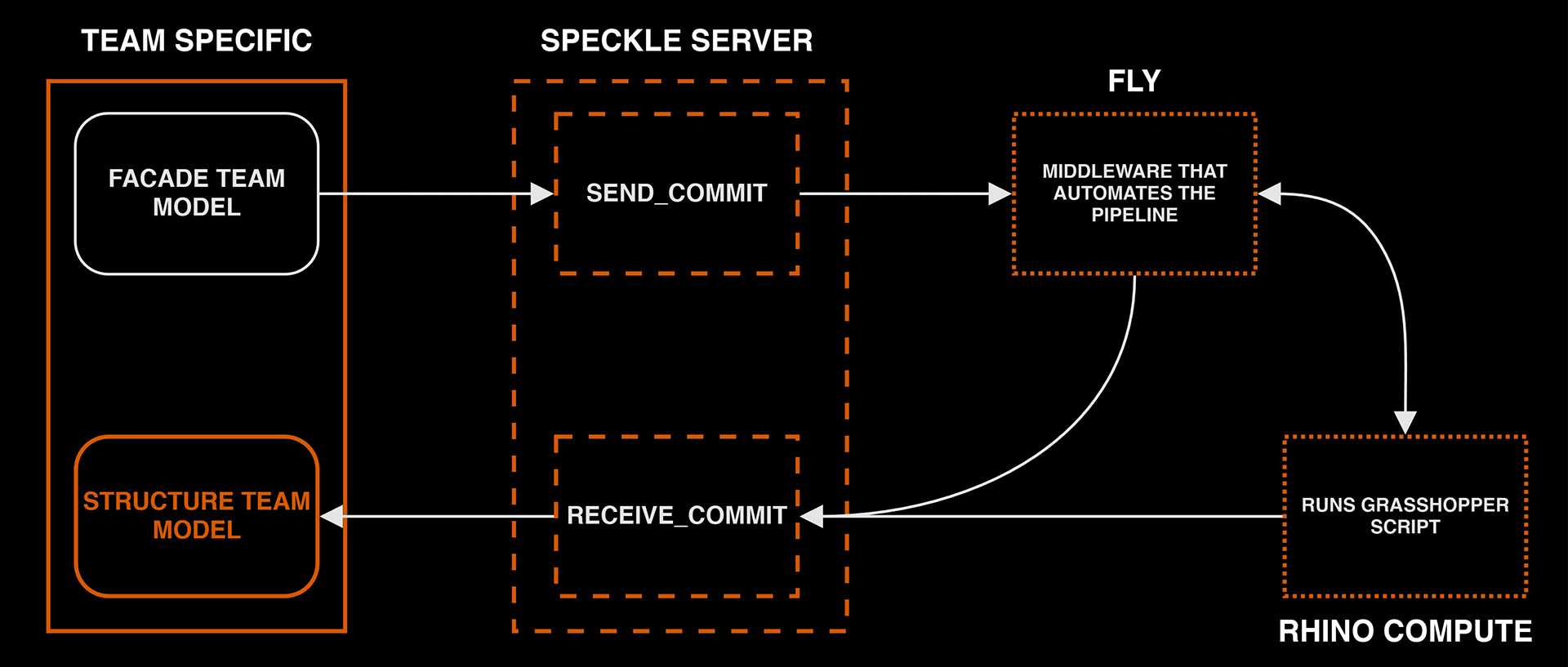
Our structural workflows depended on constantly evolving inputs from the Services (massing) and Façade (envelope) teams, so doing every update by hand (download → run Grasshopper → export → re-upload) quickly became a bottleneck. We replaced this with an automated cloud workflow: Speckle handled versioned geometry exchange, Fly detected upstream changes, and Rhino.Compute re-ran our Grasshopper definition automatically, publishing updated structural outputs (slabs, exoskeleton) back to Speckle so the shared model stayed in sync while we focused on design iteration.
Our structural workflows depended on constantly evolving inputs from the Services (massing) and Façade (envelope) teams, so doing every update by hand (download → run Grasshopper → export → re-upload) quickly became a bottleneck. We replaced this with an automated cloud workflow: Speckle handled versioned geometry exchange, Fly detected upstream changes, and Rhino.Compute re-ran our Grasshopper definition automatically, publishing updated structural outputs (slabs, exoskeleton) back to Speckle so the shared model stayed in sync while we focused on design iteration.
A demo of the automated workflow can be found here.
MEASURING WHAT MATTERS: KPIs
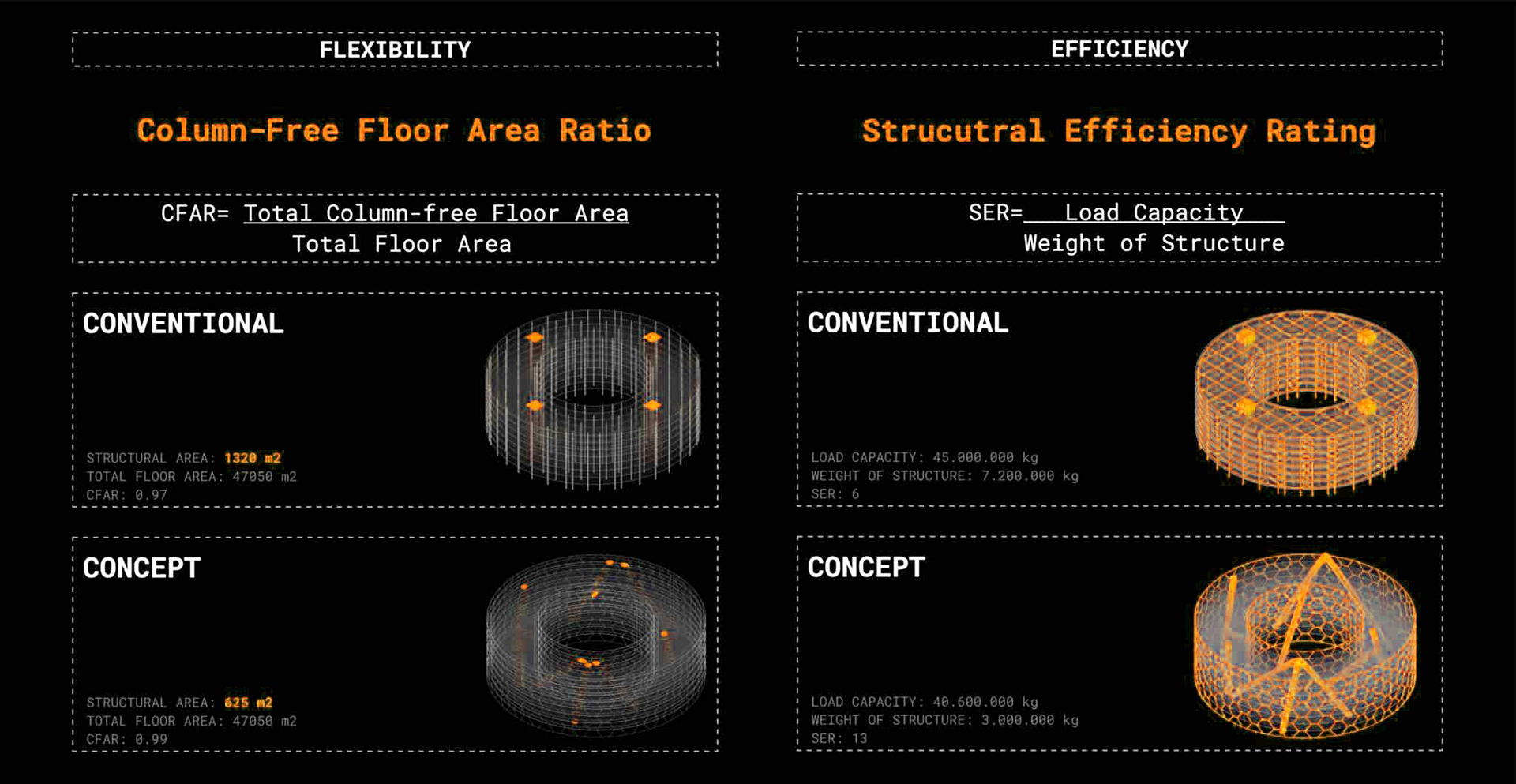
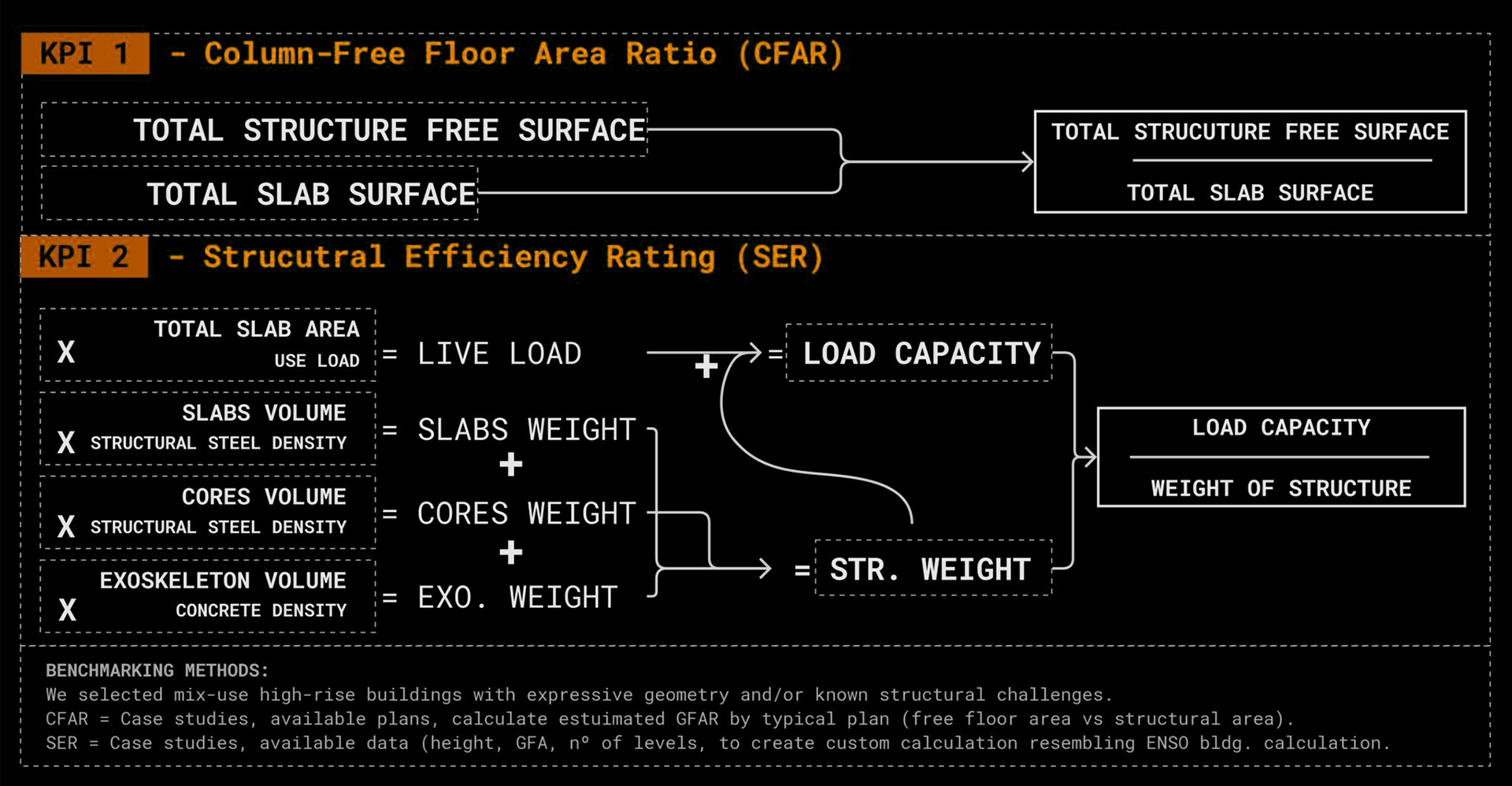
To evaluate the performance of this ambitious structure, we developed and implemented two Key Performance Indicators (KPIs):
Column-Free Area Ratio (CFAR)
Measures the proportion of the floor area unobstructed by columns—directly linked to spatial flexibility.
Measures the proportion of the floor area unobstructed by columns—directly linked to spatial flexibility.
Structural Efficiency Rating (SER)
Assesses how efficiently the structure supports live loads compared to its own weight—an essential metric for sustainability and feasibility in complex designs.
Assesses how efficiently the structure supports live loads compared to its own weight—an essential metric for sustainability and feasibility in complex designs.
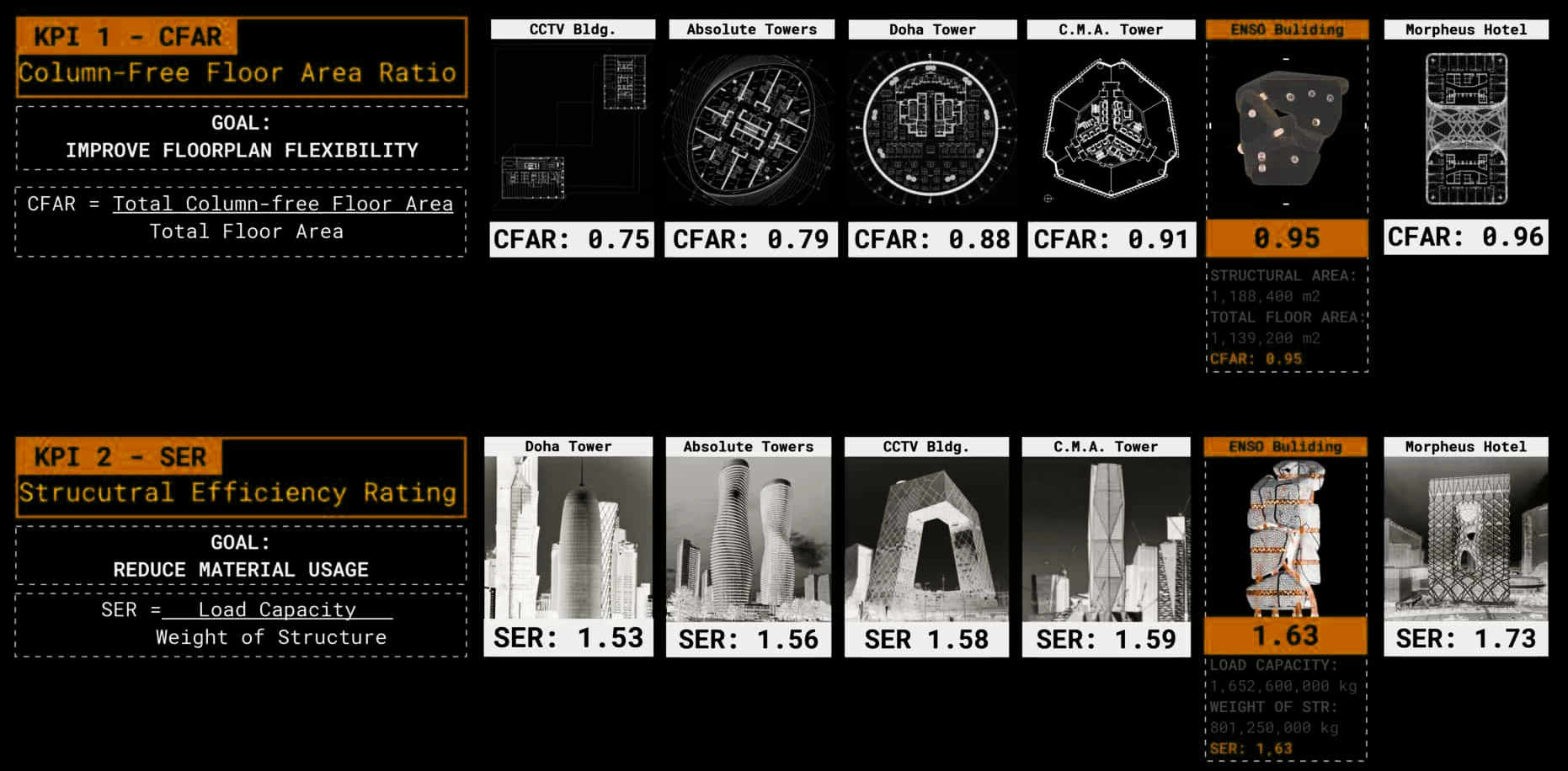
We benchmarked both metrics through simplified case studies, demonstrating how our concept performs compared to existing structural systems.
To validate our system, we benchmarked it against known high-rise buildings that combine expressive geometry with complex structural requirements.
We compared CFAR and SER across the case studies and found that Hyper A consistently outperformed the average. Its:
1) CFAR score reflects a highly flexible floor plan, and
2) SER score indicates that the structure supports loads more efficiently than most comparable buildings—surpassing the average benchmark SER of 1.55.
FINAL WORDS
The final elevations reveal the project’s cohesive expression. You can see how the topological cores, the node levels and the exoskeleton come together into a structurally sound and visually striking composition. These elements not only support the building but shape its character, define its flow, and enable its functions—internally and externally.
The final elevations reveal the project’s cohesive expression. You can see how the topological cores, the node levels and the exoskeleton come together into a structurally sound and visually striking composition. These elements not only support the building but shape its character, define its flow, and enable its functions—internally and externally.
In Hyper A, structure is not just something that holds the building up—it’s something that shapes how people move, interact, and inhabit space. We have aimed to create a system that does more than meet structural demands; it enhances architectural freedom, encourages social connectivity, and optimizes performance at every scale.