YEAR: 2024
NATURE: Academic
LOCATION: Earth & Beyond
UNIVERSITY: IAAC
COURSE: Adaptive Design Studio
TEAM: Joaquín Broquedis, Andres Espinoza, Filippo Batavia
GRADE: 9/10
Morpho Residences was developed within IAAC’s ACESD studio as a parametric “building recipe”: a single Grasshopper definition that can generate adaptive residential buildings around the globe. Rather than designing one fixed outcome, the project encodes architectural rules into an expandable system that can be re-run under different contexts and constraints.
The definition takes plot, terrain, FAR, and location/climate as primary inputs, and uses rule based aggregation algorithms to assemble apartments of different typologies into coherent building blocks. By coupling site conditions with modular aggregation logic, Morpho Residences produces context-responsive massing and organization—allowing the same recipe to be deployed on radically different sites while maintaining a consistent architectural intent and with adaptive and functional buildings as a result.
DESIGN STRATEGY & TYPOLOGY
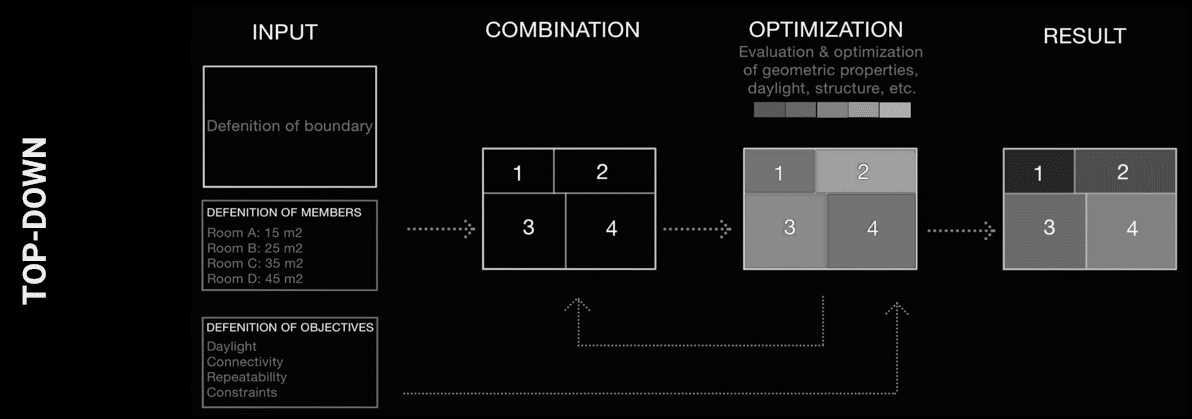
Morpho Residences is a top-down, rule-based computational system: predefined rules drive the geometry and its outputs. The chosen typology is a mixed-use residential block. The goal is to obtain flexible, adaptable and climate resilient housing units that respect the local ecosystem.
CORE PRINCIPLES
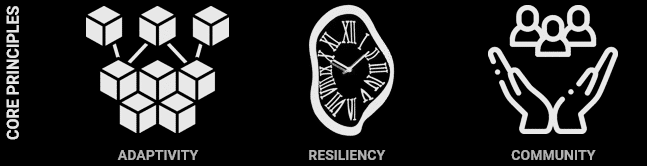
Three core principles are to be found throughout the whole project. Adaptivity by allowing change in the living spaces and typologies, Resiliency by presenting different approaches to different climate scenarios and Community by focusing on the well being of the inhabitants through quality spaces and contact to nature.
WORKFLOW
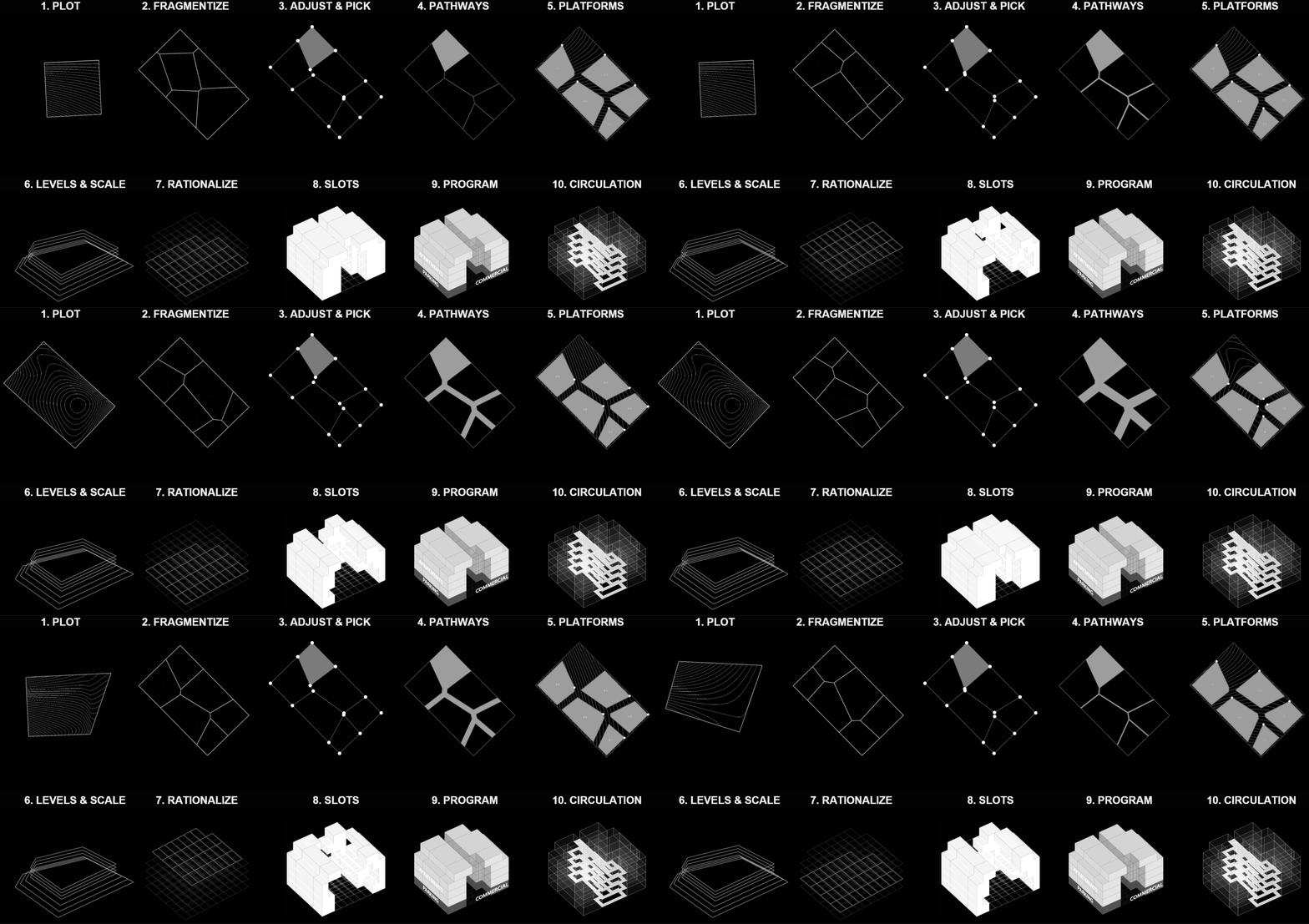
A single Grasshopper “recipe” generates an adaptable building from key inputs such as plot, terrain, FAR, and location/climate. Outputs include controllable parameters like FAR, apartment mix, and ground-floor areas, enabling rapid iteration while keeping the system consistent across sites.
The plot is fragmented using a Voronoi-based approach, then rationalized into buildable subplots. Buildings are placed on terrain-adaptive platforms, lifted to meet the required FAR, then scaled to create terraces and outdoor spaces. Finally, rationalized “slots” enable apartment aggregation with variable unit sizes while keeping max depth at 12m for daylight.
Program is split into residential above and commercial/public on the ground floor. Circulation is positioned in the voids between apartments, turning the in-between space into a social interface and strengthening community.
Two early-stage optimizations drive both performance and quality. Voronoi partitioning optimization produces more rational plots (cell area, point count, cell lengths) while solar radiation optimization maximizes facade exposure; building heights vary to distribute sunlight and support facade energy strategies. In the case of hot climates, counter measures to reduce overheating, such as balconies, optimized WWRs and shading structures will be applied to the facade in a later stage. All these measures are predefined for each one of the climate types shown and are based on common practice for the vernacular architypes of each location.
MODULE DEFINITION
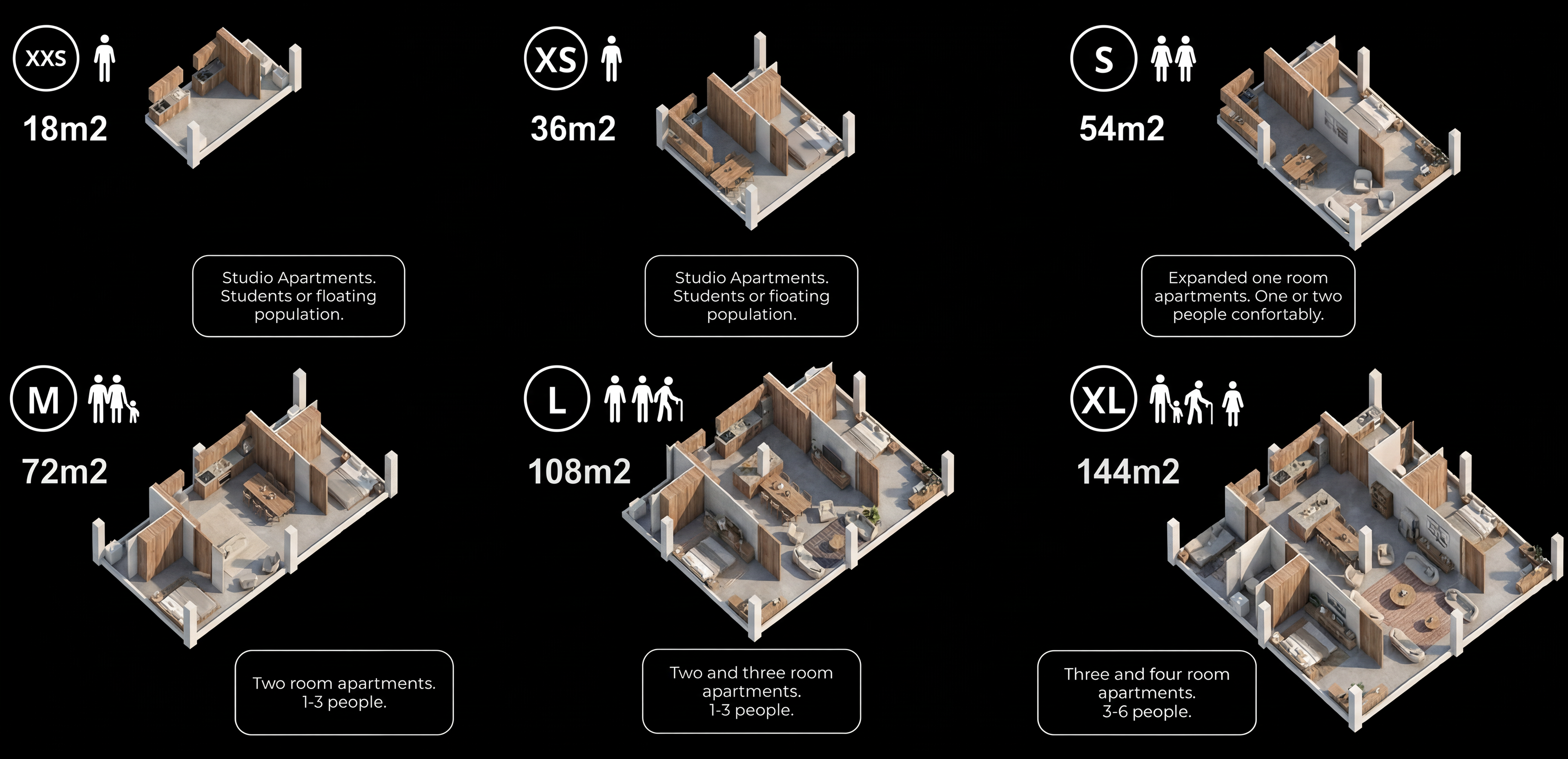
When it comes to the apartment units, we designed 6 different typologies based on a conceptual grid of 3 by 6 meters, which is complementary to the 6 by 6 meters grid of our structural system. The apartments are thought to be flexible and adaptable, allowing for a wide range of occupants and lifestyles. This is achieved by solving all the interior spatial connections with sliding doors towards the perimeter of the units, allowing to expand or collapse the different rooms depending on use case. We also left room layouts simple to ensure different interpretations of the space.
CASE EXAMPLES
SINGAPORE
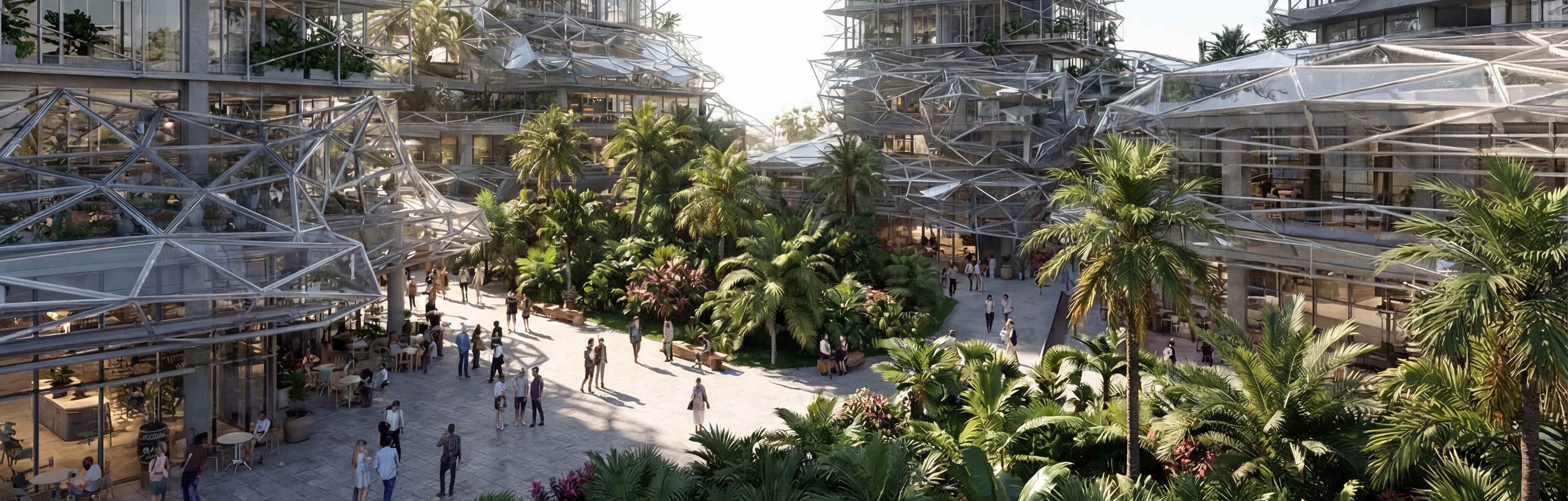
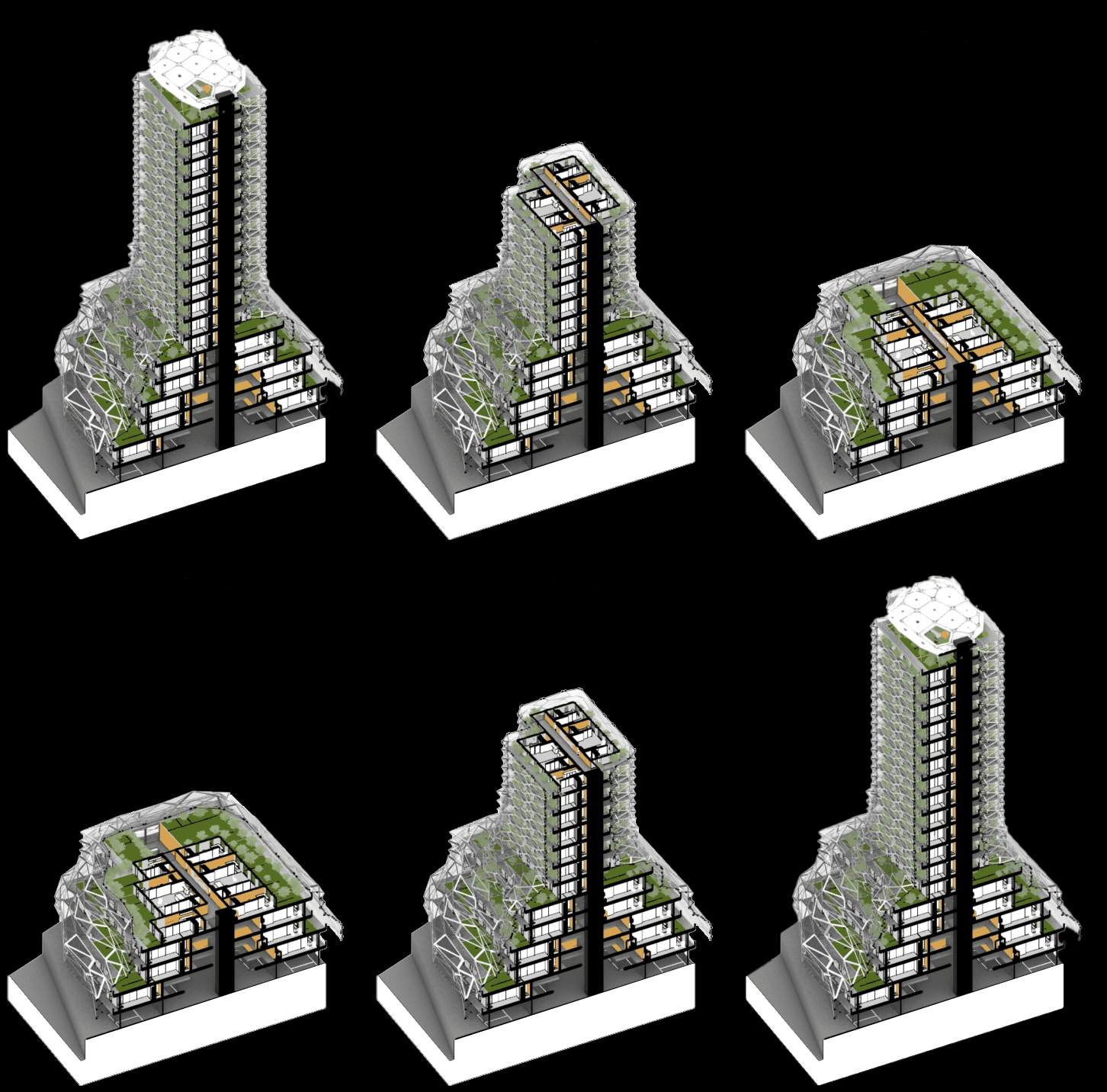
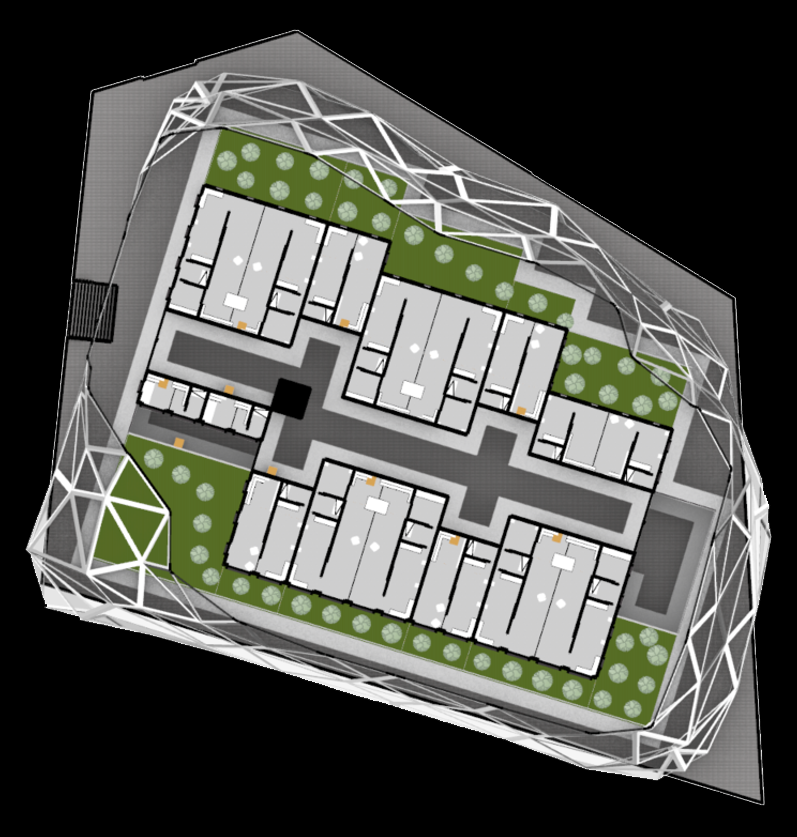
The sections and floorplans of the instantiation of our building in Singapore show how the the section scales down towards the top, creating more wind-flow between the towers in this hot-humid climate. Furthermore, it creates a terraced landscape on the first few floors. Vegetation is placed on terraces and balconies to provide cooling. The second skin offers shading, provides climate control to the users and creates a favorable space for vegetation to grow. Also, the publicly accessible ground floor can be seen in the section, creating a relation between the buildings and the urban environment.
The sections and floorplans of the instantiation of our building in Singapore show how the the section scales down towards the top, creating more wind-flow between the towers in this hot-humid climate. Furthermore, it creates a terraced landscape on the first few floors. Vegetation is placed on terraces and balconies to provide cooling. The second skin offers shading, provides climate control to the users and creates a favorable space for vegetation to grow. Also, the publicly accessible ground floor can be seen in the section, creating a relation between the buildings and the urban environment.
REYKJAVIK
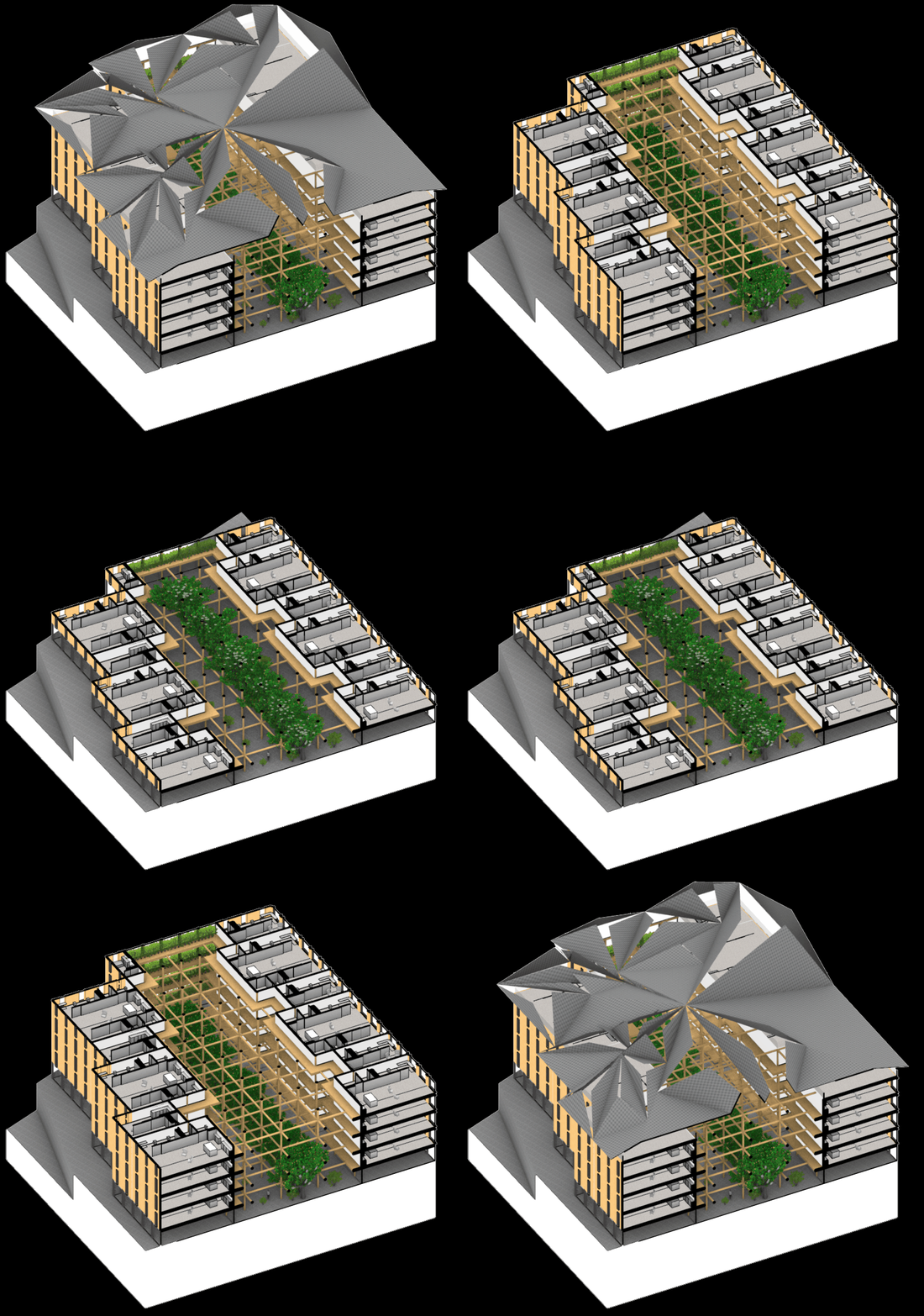
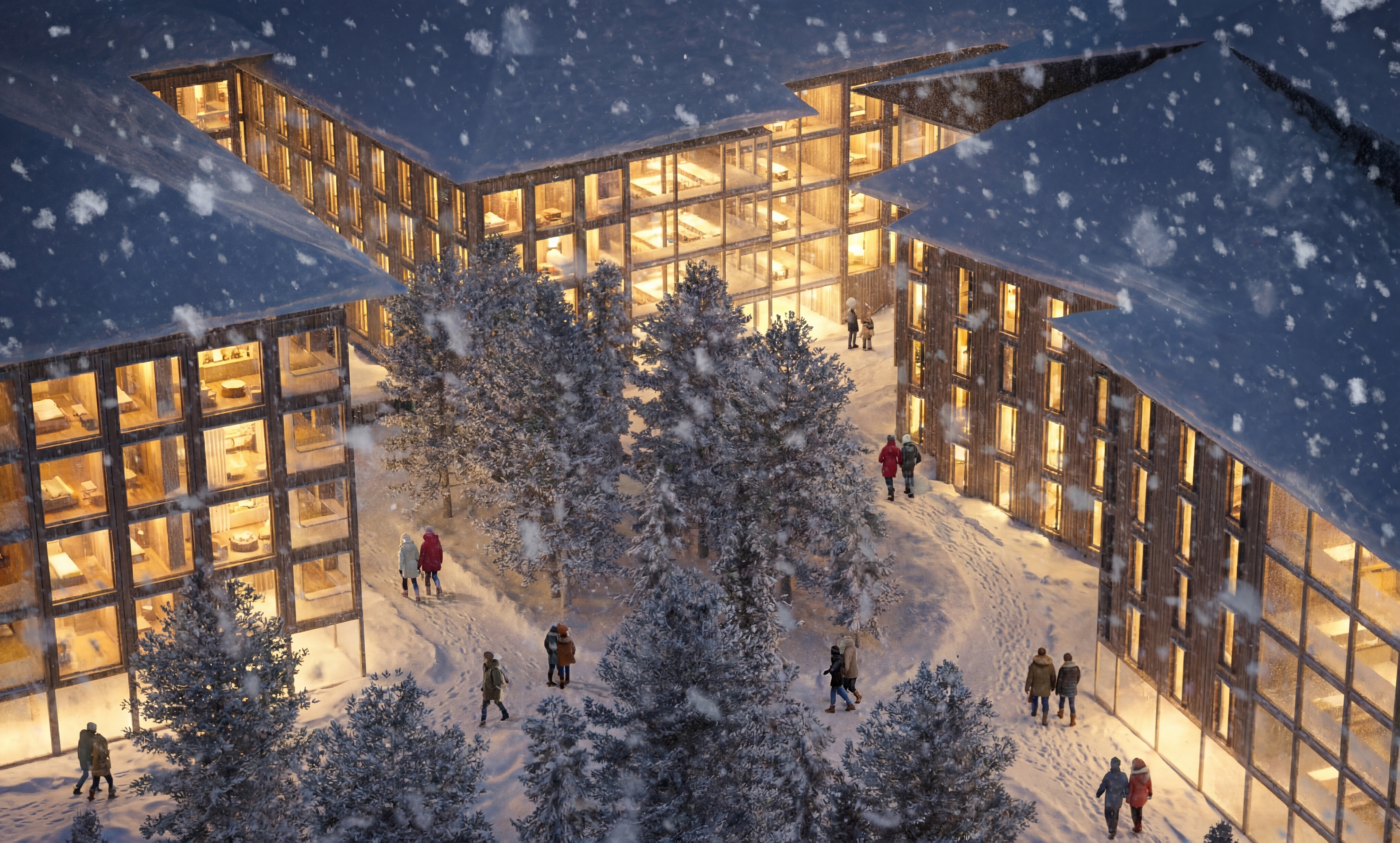
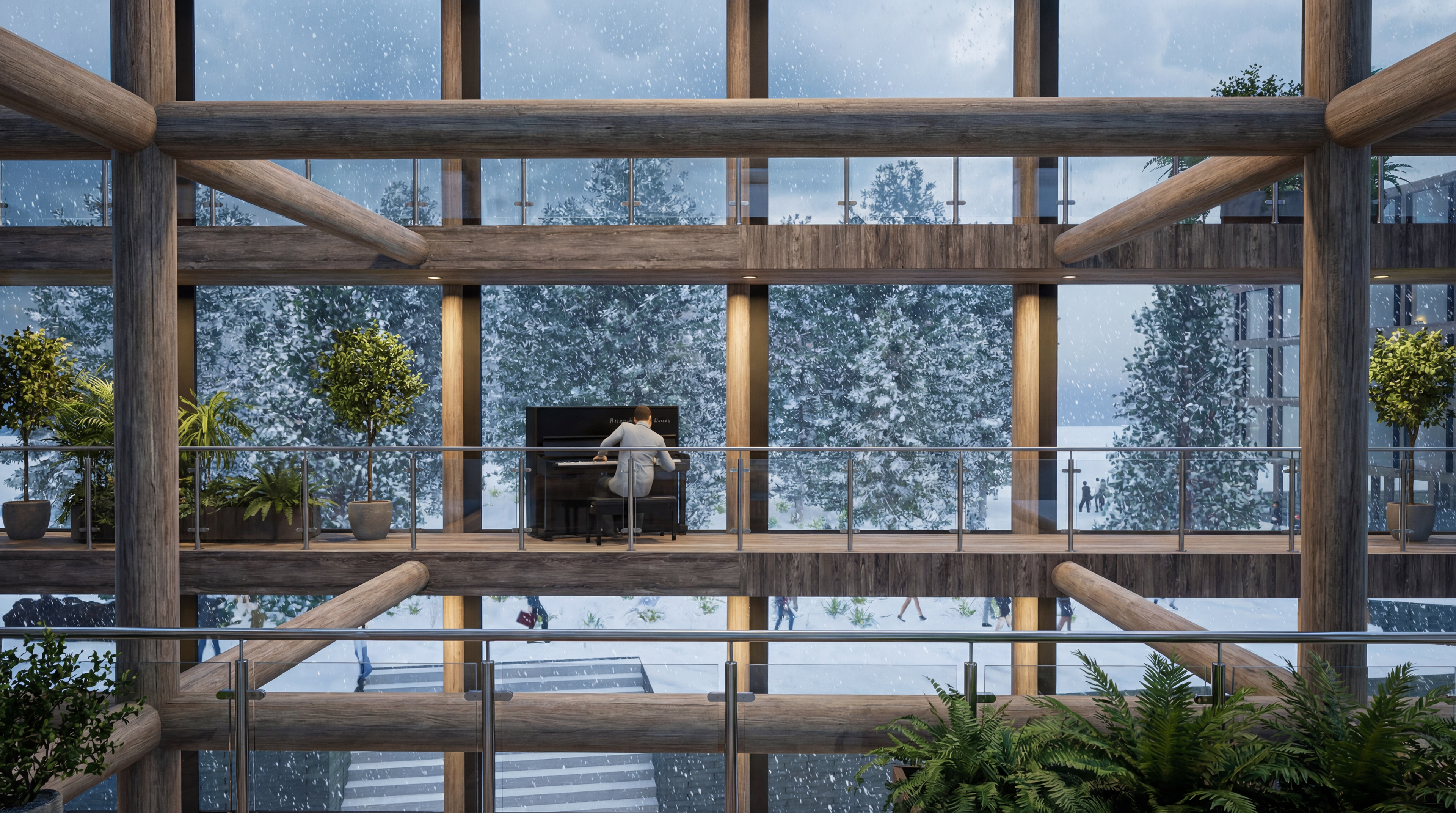
The sections of Reykjavik illustrate well how the buildings adapt to different climates, in this case creating a larger atrium, containing a covered courtyard that serves as a common space, fostering connections between residents. Where in Singapore, the vegetation is located on the outside in order to create a cooling effect, In Reykjavik it is located on the inside so that also in this climate residents can enjoy having a garden. Instead of a second skin, the buildings in Reykjavik have kinetic roofs that follow the sun path to let through light but can also be closed depending on the weather conditions.
The sections of Reykjavik illustrate well how the buildings adapt to different climates, in this case creating a larger atrium, containing a covered courtyard that serves as a common space, fostering connections between residents. Where in Singapore, the vegetation is located on the outside in order to create a cooling effect, In Reykjavik it is located on the inside so that also in this climate residents can enjoy having a garden. Instead of a second skin, the buildings in Reykjavik have kinetic roofs that follow the sun path to let through light but can also be closed depending on the weather conditions.
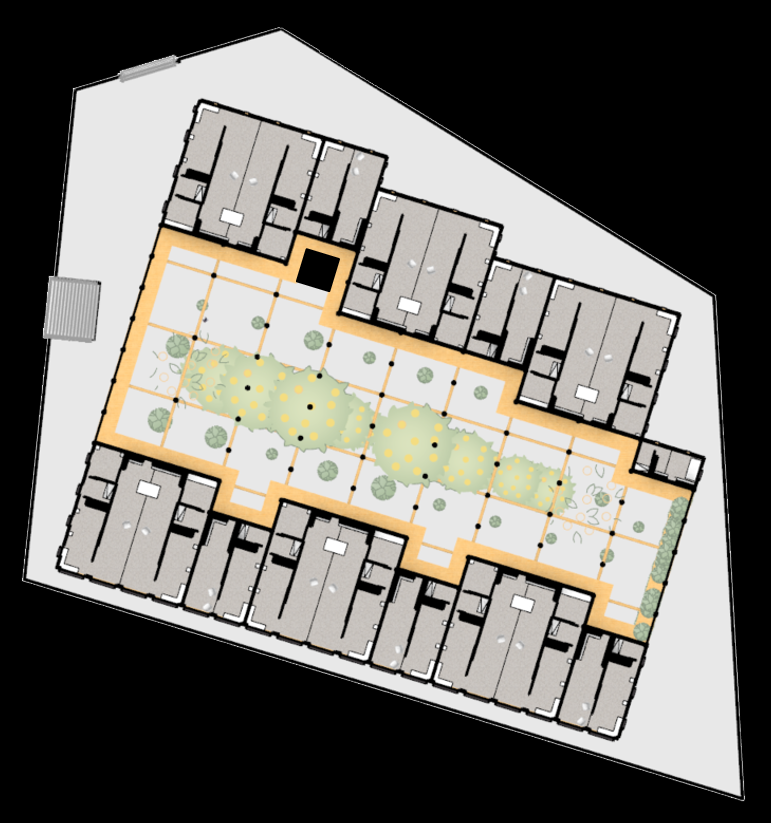
The climate presets generate different levels of building reconfiguration, allowing for completely different results based on the location. In the case of Singapore, a double skin facade is implemented and a covered communal garden is created on the roof. In the case of Reykjavik, balconies are not generated, the windows on the south facades are bigger than the one on the north for maximizing solar radiation, for the same purpose we created a kinetic roof, deconstructed in triangular shapes to allow it to open and close dynamically based on the solar position.
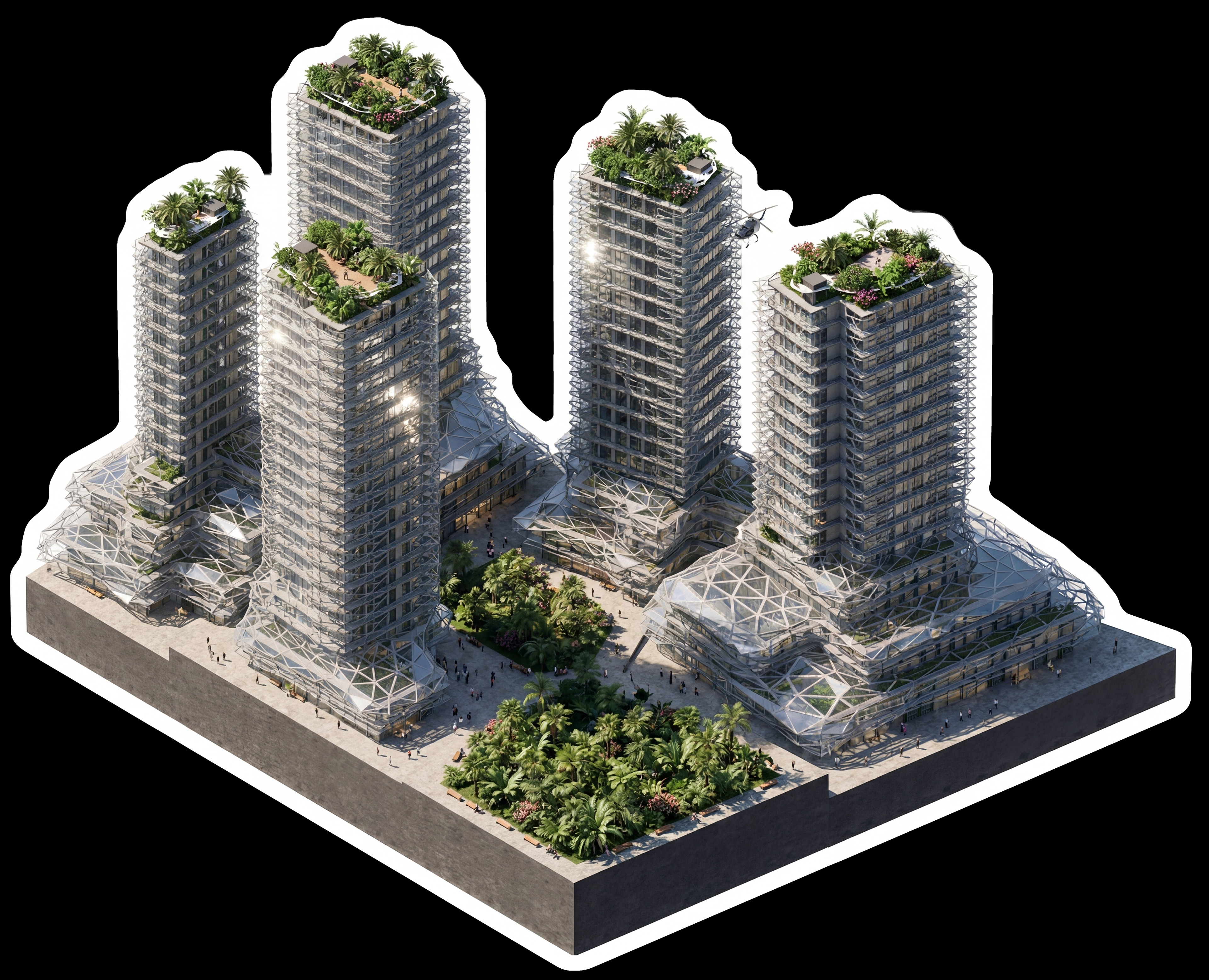
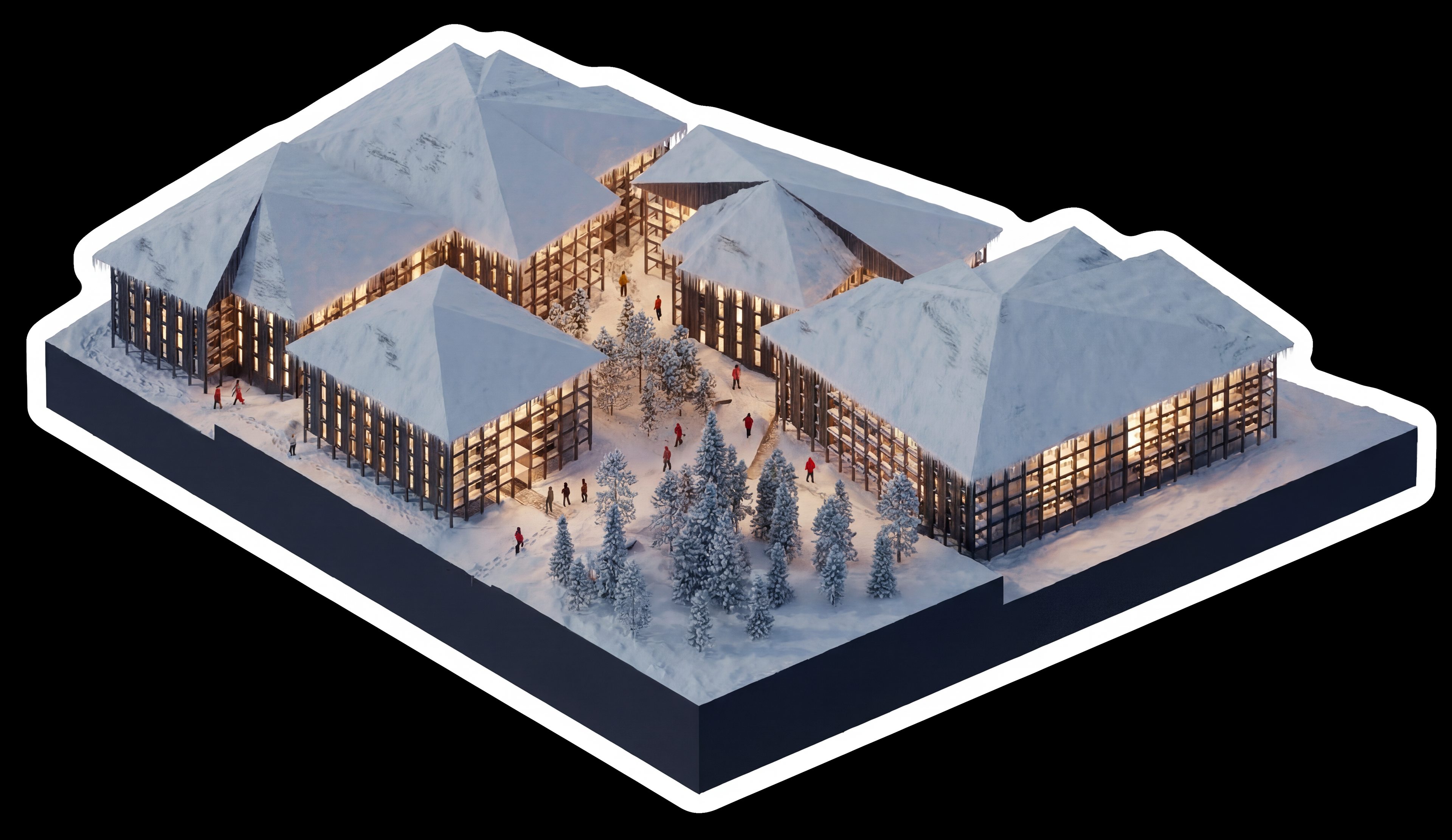
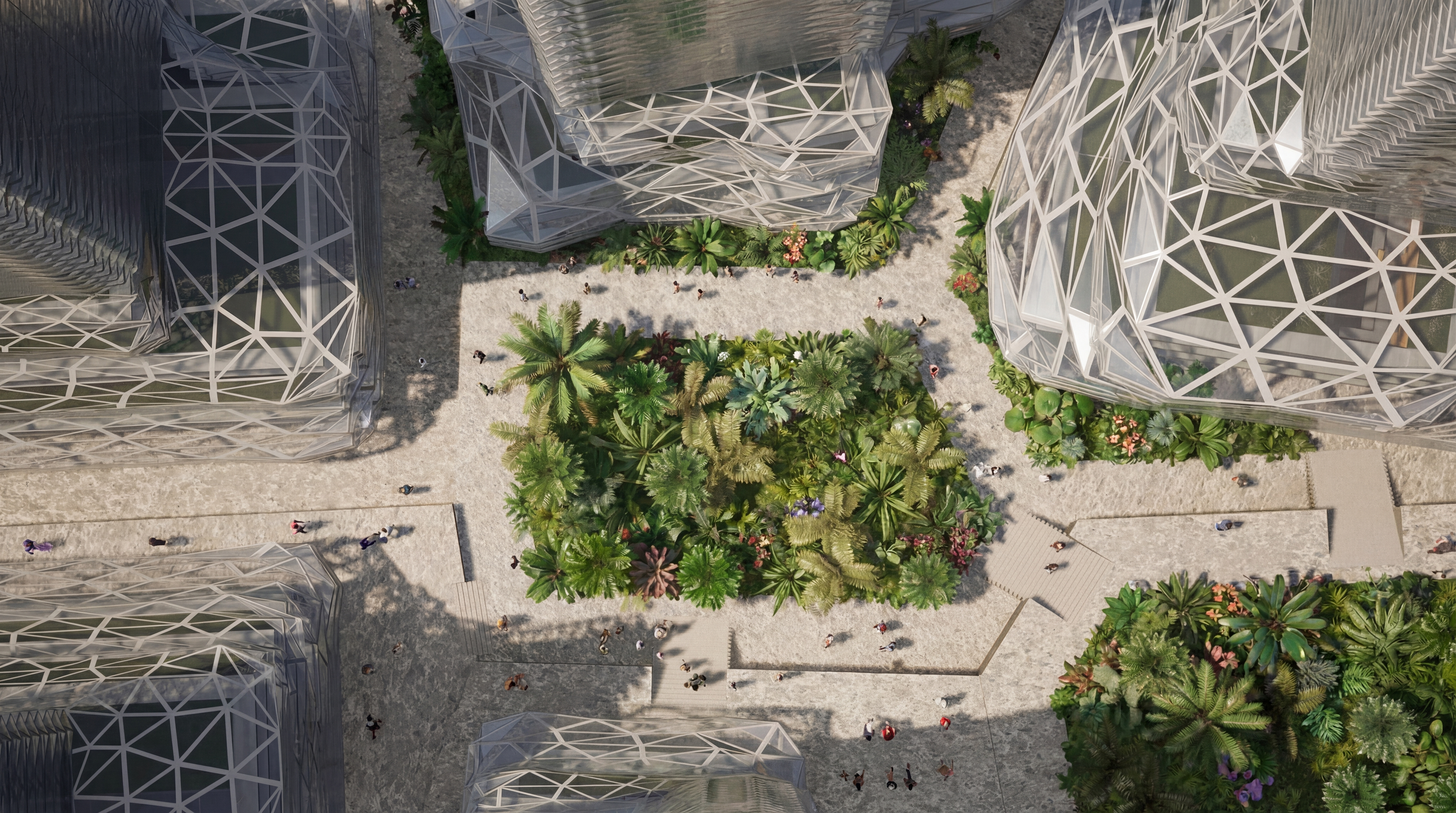
From the renders, it is clear how some areas of the building like the atrium remain an iconic and functional element of Morpho in every climatic situation, but the primary and secondary climate adaptations generate significant formal variations. Morpho is born from the very idea of adaptability, to climate, urban and living constraints.
LUNAR MODE | EASTER EGG
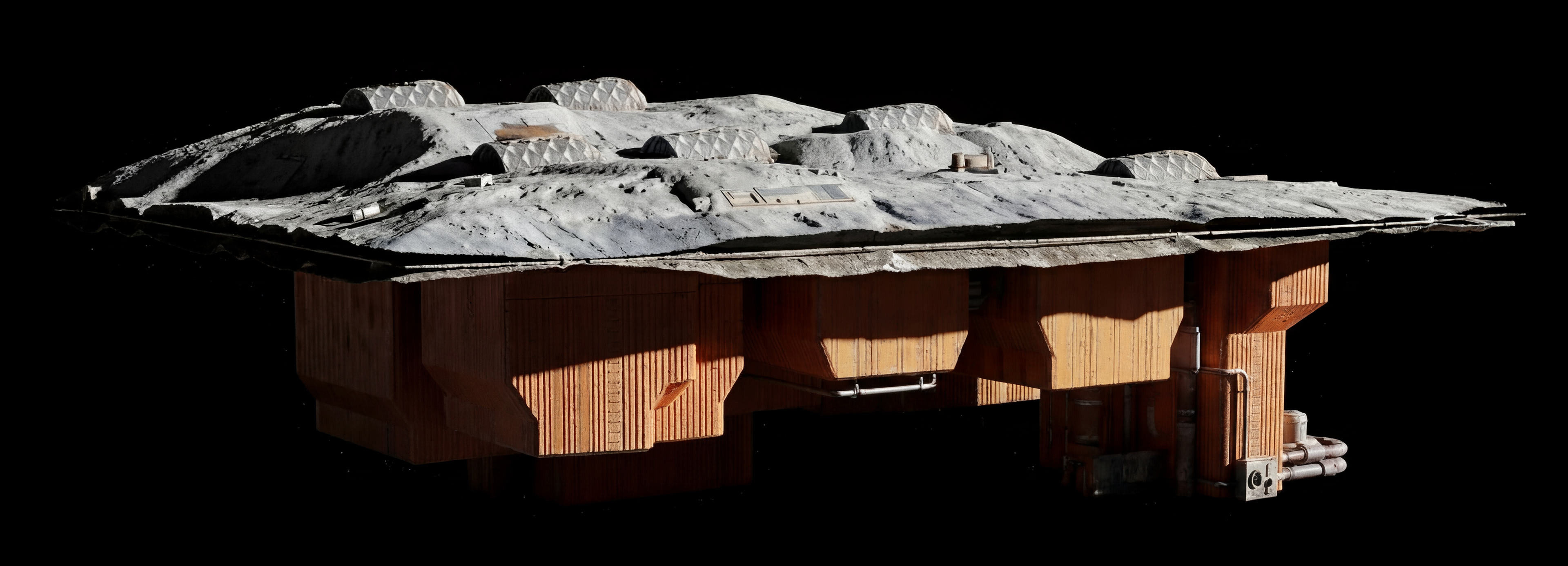
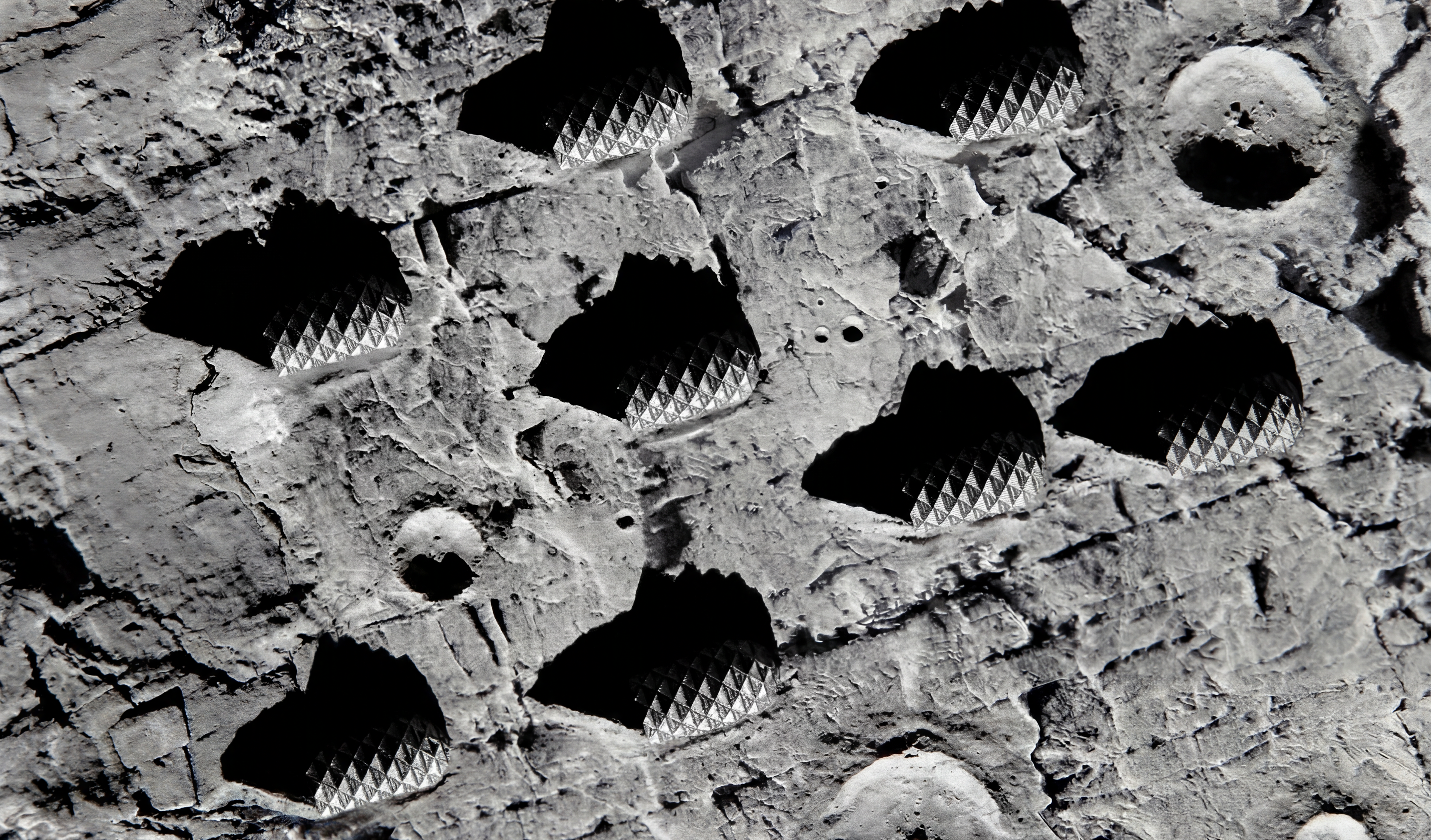
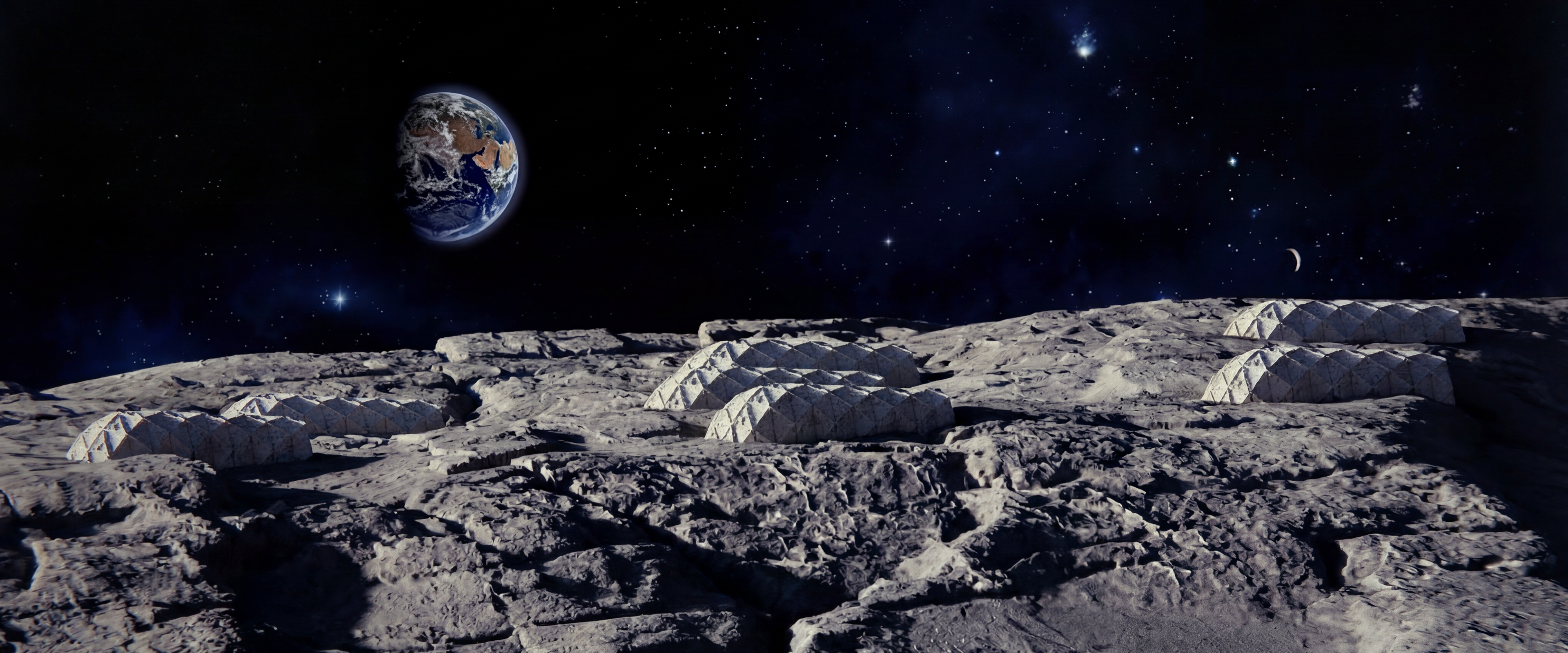
We have added an additional level of customization for a hypothetical application of the script to a lunar plot for the construction of a habitat. The logic remains the same as used previously, but the floor are inverted for an underground construction, that is intended to be 3d printed using materials directly taken from the moon surface, while inflatable entry structures are placed on the surface to allow depressurization and vertical circulation.
This emphasizes at the flexibility of our building generator.
STRUCTURE | PRINCIPLES
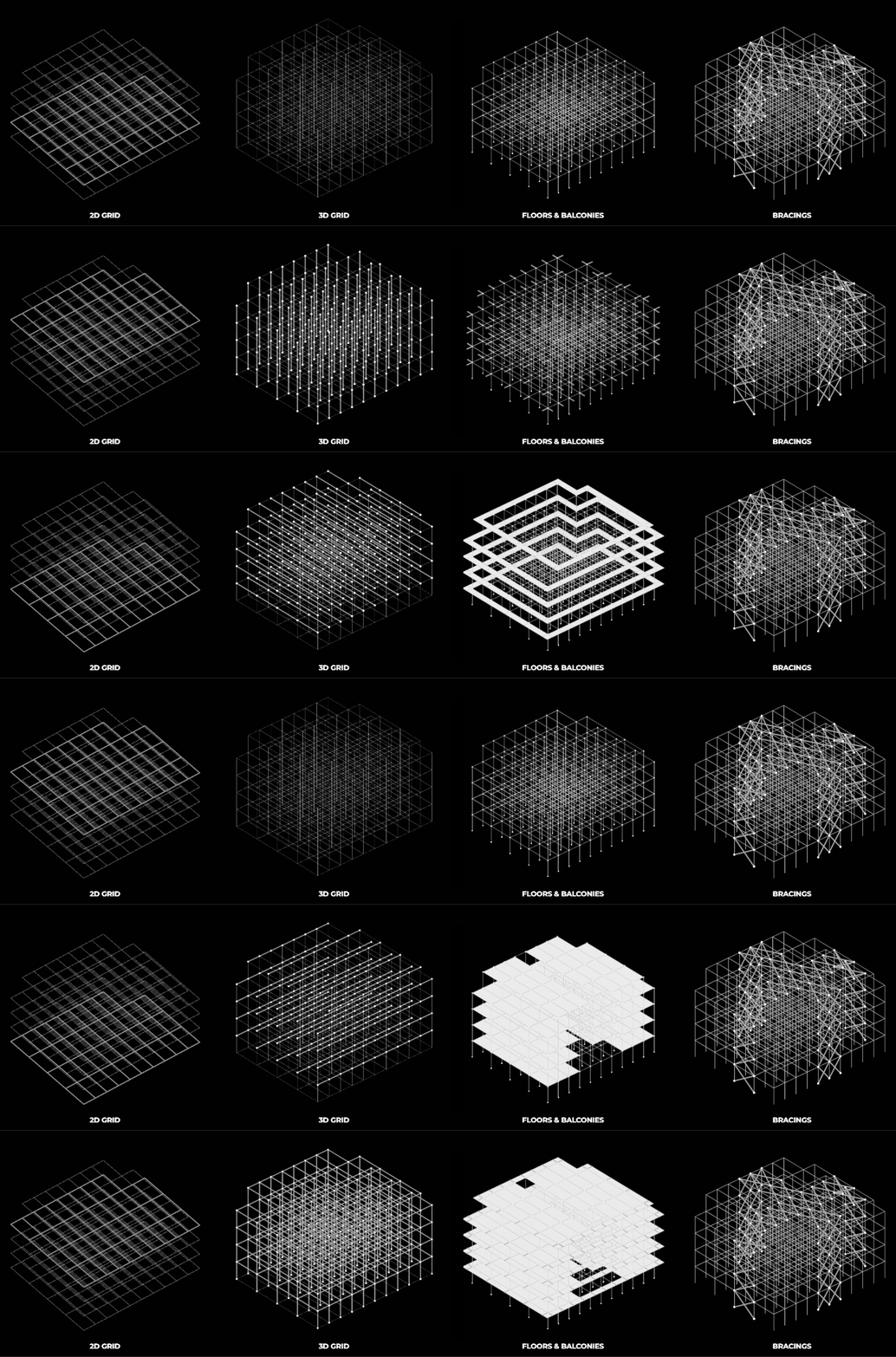
The definition includes a structural optimization section that applies the right material and cross sections to the specific project. The geometry of the buildings is decomposed into first a 2-dimensional grid of beams and then into a 3-dimensional grid of beams and columns. The 2D grid size is 6m x 3m and the height is variable depending on the climate, either 3m or 4m. Floors and balconies are placed on the structure while slabs and mainly bracings ensure the stability of the building. This decision has been made to offer great flexibility and to allow the reorganization of apartment sizes according to whichever need for new living typologies arises in the future. All structural elements are directly derived from the algorithm that creates the buildings.
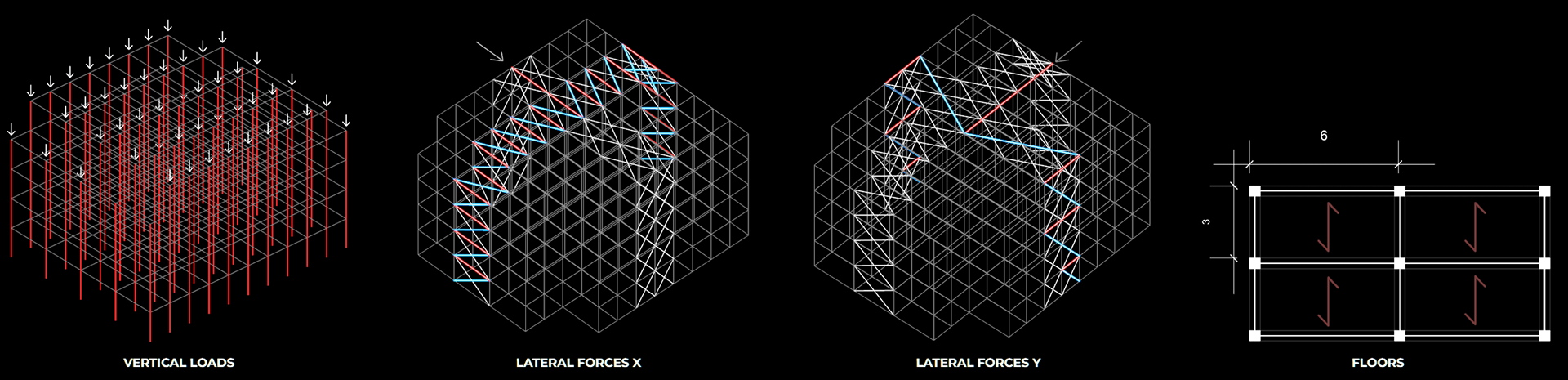
As illustrated above, vertical loads are transported through the columns while lateral forces such as wind are dissipated through the bracing elements, for x and y axis. The combination of this elements intends to generate a stable shape, aimed to be modular and pre – fabricated in the material that suits the project’s location better. The floor spans in the shortest direction of 3m, giving us a guideline for the distribution of main and secondary beams afterwards.
STRUCTURE | OPTIMIZATION
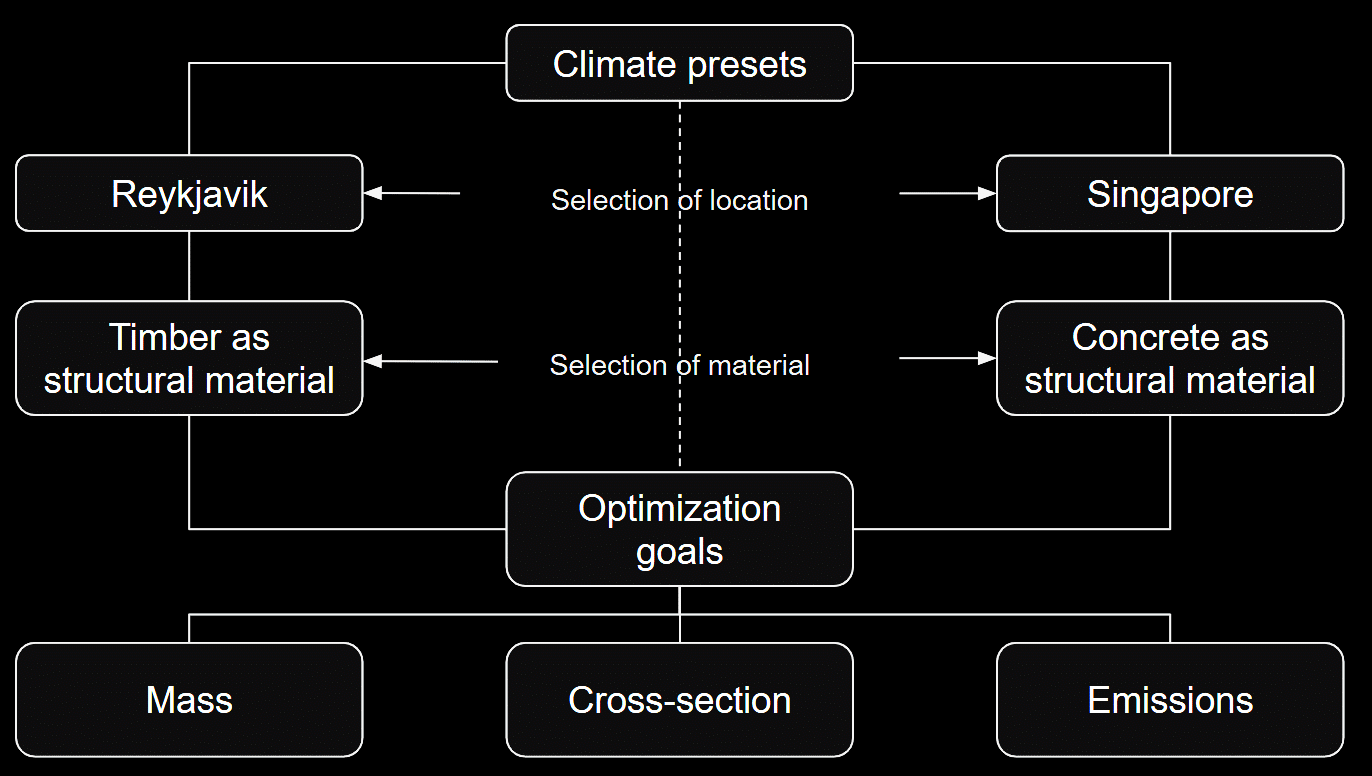
We have developed two different structural systems based on two different climates: for Reykjavik we decided to use timber. For Singapore instead we will be using concrete. The main optimization goals were: minimize the mass and the cross-section of the elements and by doing so also the CO2-Emissions of the structure.
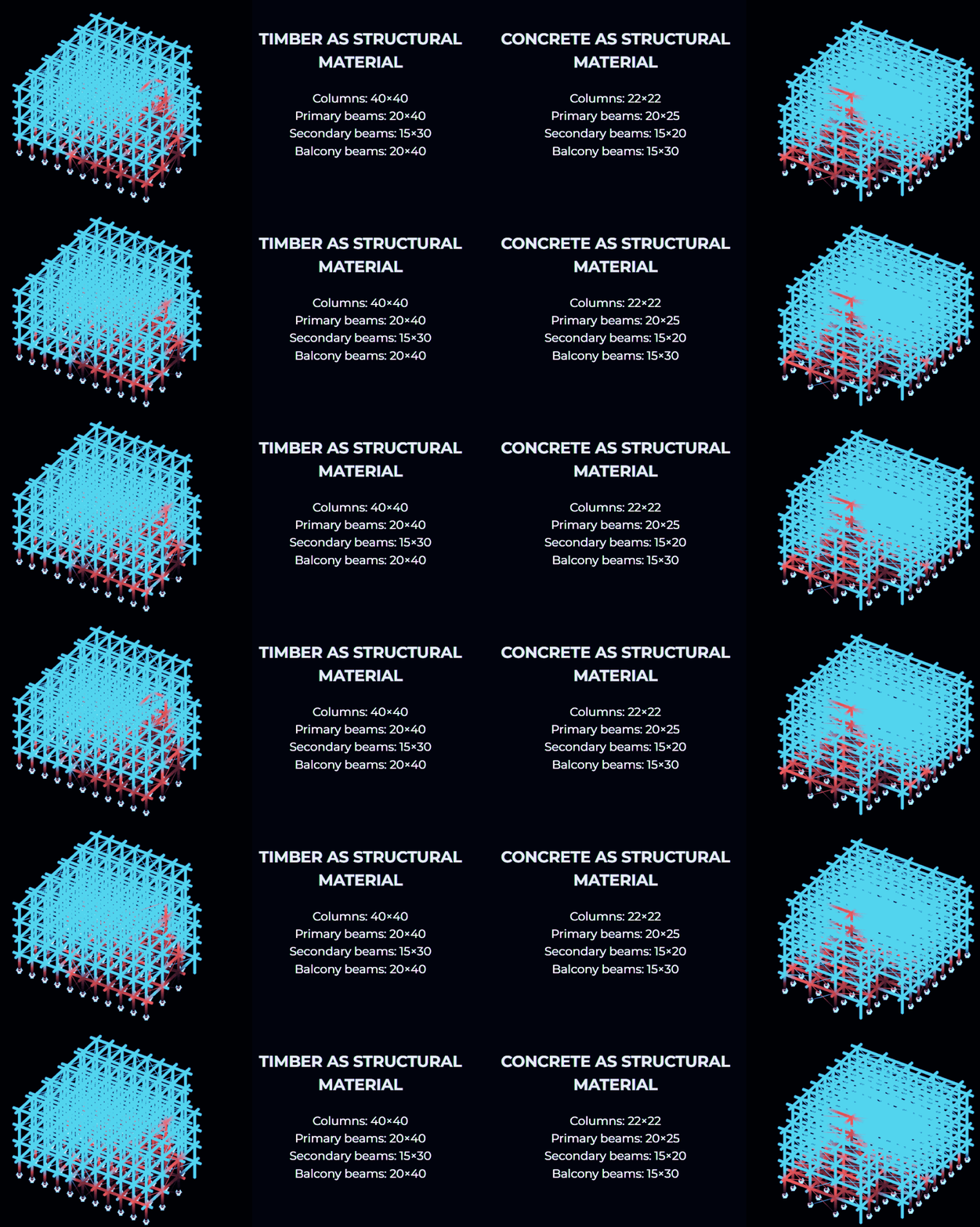
Lastly, Here we can see how the different components have been optimized to achieve the previous goals. For instance for the concrete structure, columns have been dimensioned with 22×22 cm, primary beams with 20x25cm, secondary beams with 15x20cm and lastly balcony beams with 15×30. This represents the optimized outcome of the process.